Showing posts with label Black-necked Grebe. Show all posts

18 Feb 2025

18 Feb 24 - Making A Spectacle Of Itself

On 13 Jan 25, news broke that a male Spectacled Eider had been found on the island of Texel, in Holland (pronounced Tessel). This is only the seventh Western Palearctic record of this mythical Seaduck. There are five previous accepted records being seen high in the Arctic: three records from Finnmark in North Norway and two Svalbard records. In early Nov 24, A male was also briefly seen near Reykjavik, Iceland, but it wasn't relocated. I wonder if this is the Texel individual.

I was immediately interested in a trip to see the Spectacled Eider, if it stuck around. However, there were two problems stopping me heading off. One was the pale phase Booted Eagle had been found the day before in Cornwall and due to prior commitments, I had been unable to head West to look for the Booted Eagle until 16 Jan. The second was I was due in Pompey on 20 Jan, as I was one of the Wildlife Guides in the first ORCA team on a Saga Cruise in the 2025 season. Before I headed off for the cruise, Pete Moore had asked if I was thinking of heading to Texel and we hatched the beginnings of a plan for a trip during the Feb half term.

I was keeping track of the news on the Spectacled Eider which I was on the cruise and was pleased to see it was being seen daily along the East side of Texel. When I returned, I discussed dates with Pete for his first European twitch. To be honest, I've only been on one mainland European twitch to see the gorgeous and confiding Hawk Owl that turned in Zwolle in Holland in Nov 13. But I've been on eleven twitches to Ireland over the years.

If you have a few days available, a mini-break trip to Holland provides plenty of Birding and sight-seeing options. We favoured heading over on the evening of Mon 17 Feb and taking the ferry from Harwich to the Hook of Holland. While this was a bit more expensive that travelling via Calais or Dunkirk, it would be only be a couple of hours journey to the Texel ferry and it would give us about seven hours of sleep. I was happy to drive as I'm insured to take my car to Europe for three months in a year. The car's built in European Sat Nav is a nice advantage. Our plan was to have a day and night on Texel, before heading off to Lelystad to the North East of Amsterdam for a Pygmy Cormorant, which would be a bonus Tick for Pete. I would then drop him to catch a train into Amsterdam to meet up with his wife, Claire and youngest son, Rowan. I had a rough plan for an extra day or two in Europe, but more of that in future Blog Posts.
Green ideas, Dutch style: There were a lot of wind turbines across the country, especially in the more open Western side. Even, the car is being transported in a green way
I picked Pete up in his Wareham house about 15:30 and we were soon heading for Harwich. The check-in for the 23:00 ferry to the Hook of Holland closed forty-minutes before the ferry's departure. We thought we had an hour of time when we could find some food that evening and still arrive well in time for the ferry. We expected to hit the M25 around the rush hour, but being half term, we were banking on the traffic to be lighter than normal. As we got close to the M25, Pete said there was a two hour or so delay on the North bound route and my Sat Nav was showing heaving congestion on the South bound route. We weren't going to risk the long delays on my preferred route, so I would have to head for the Dartford Tunnel and add the toll into the cost of the trip. It was a slow crawl through Surrey and again at the Tunnel, but finally the traffic improved once we were North of the Thames. We arrived at the port about 21:30 and we were quickly through immigration. Surprisingly, we didn't have to wait for the next hour before could board the Stena ferry. By 22:15, we had had a look around the ship, found our cabin and bunked down for the night.
After about two & a half hours driving, we were in Den Helder: The ferry to Texel departs from the North end of the town
The alarm was set for 07:00 European time, to give us an hour for some breakfast and drinks in the cabin before our arrival. However, the ferry decided to wake us thirty minutes earlier, to advertise the restaurant was open. Still we had had a good night's sleep. We were quickly off the ferry and through the Dutch immigration with just one small worry. My car had the old GB numberplates. One of the million or so failures that Johnson's was responsible for, was the GB numberplates are no longer legal in Europe. We needed a UK sticker or new UK numberplates without the EU symbol on them. Due to a misunderstanding, the metallic sticker Pete brought along was also a GB one. I was worried I would get pulled over by the police at some point in the trip, but fortunately that didn't happen. I will have to get a new UK metallic sticker before I head off abroad again.
HNLMS Tonijn (S805): This is one of the main exhibits in this interesting-looking Naval Marine museum in Den Helder. Something I will have to check out if I get back to Texel
HNLMS Tonijn (S805): She was commissioned in Feb 1966 and decommissioned in Jan 1991
The Texel ferry departs from Den Helder on the half hour, for the twenty minute crossing to Texel. It was clear that it was going to be very tight to connect with the 10:30 ferry, having encountered slow traffic as we left the Hook of Holland. I wasn't wanting to race to try to catch that ferry while I adjusted to driving a UK car on the wrong side of the road. But we could take it steady and easily arrive in time for the 11:30 ferry. The Texel ferry is very impressive as it is a community-owned, not for profit ferry to benefit the islanders. Such a contrast to the Studland ferry which is owned by a hotel chain that wants to massively increase ferry prices to prop up the struggling hotel chain. Pete had been pre-warned by James Lowen, that we should pre-book the ferry. The twenty-eight euro return ticket was valid for a mid-week departure on any ferry. They have numberplate to speed up the check-in process. Perhaps the Scottish government should get the TESO company to run the ferries to the outer islands, as these ferries would be a massive improvement on the current Calmac fleet.
The Texel ferry approaching Den Helder: There is a ten minute loading and unloading time and a twenty minute crossing time, with a second ferry ready to cope with busy times of the year
Inside the Texel ferry: There is a spacious top deck area, with a cafe, plenty of seating, free phone charging and good toilets
Inside the Texel ferry
Spoonbill sign: Spoonbills and Little Terns breed on Texel
Texel Island dated : The island is about fifteen miles long and six miles at its widest. There were clearly a lot of ships wrecked on its seaward side
There are large sandy beaches at the Southern end of Texel
We were quickly off the ferry and heading for the Spectacled Eider site. Since it was found, it has been feeding on the East side of the island about three or four miles North of the coastal town of Oudeschild, with a large, scattered flock of Eider. Over the several hours we were there, it drifted North as it was feeding, before finally drifting South again to the Iron Cape Monument (shown as IJzeren zeekaap on Googlemaps). It was easy to locate where we needed to park, as it was the only place on the road next to the seawall, where there was more than a couple of cars parked.
The Texel fields are well below sea-level
This shows how low the fields are below the top of the seawall, which is another five to ten metres above the road
The parked cars for the Spectacled Eider twitch were next to this gorgeous-looking house
The Iron Cape Monument: This modern-looking structure was designed and built in 1854 as a daytime beacon to shipping. it was moved and strengthened when the seawall was raised in 1977. The Spectacled Eider was feeding in the first mile North of this obvious landmark, which is only visible once you walk up to the top of the seawall
The outer side of the seawall had a good cycle track
It was good to see this sign promoting the wildlife
It was a small twitch, but there were generally about ten birders and toggers throughout the time we were there
Eider: A small group of the hundred or so Eider feeding offshore
Spectacled Eider: Male. Although I located the Spectacled Eider quickly with the scope, it proved harder to pick up with only a 100 - 400mm lens on the camera in the choppy seas. Frequently, when I did see it, it became hidden behind waves in the time it took to take a batch of photos
Spectacled Eider: Male. Most of the time we were there, the Spectacled Eider kept near to, but separated from, the Eider
Spectacled Eider: Male. The Spectacled Eider was noticeably smaller than the Eider, with a smaller beak and lacking the long, sloping forehead of the Eider
Spectacled Eider: Male. Given they have a limited range around Alaska and the now out of bounds, adjacent Russian territory, this is a species I never thought I had much chance of seeing: especially, as the cost of the trip to Alaska is very expensive and they are not easy to see once you get there
Spectacled Eider: Male. On a number of occasions, it half rose out of the water
Spectacled Eider: Male. This is easily my favourite species of Wildfowl that I've seen & there are only fifteen species that I've not seen
Black-necked Grebe: This Black-necked Grebe popped up close to the shoreline and closer than I'm used to at Studland
Black-necked Grebe: It was good to see around ten Black-necked Grebes offshore
The photos are all very deceptive as it looks to be a nice sunny Winter's day. What they don't convey is there was a bitterly-cold twenty mile an hour wind coming straight into our faces and there was no shelter from the wind. By mid-afternoon, it was clear that the Spectacled Eider wasn't going to come any closer and I headed off to find a shop to get some food. But first, I nipped a quarter of a mile North. The coastal road is called Lancasterdijk (Lancaster Dyke), as it has a memorial to the one hundred and eighty-nine Allied aircrew who were killed on and around Texel during WW2. Many of the night-time bombers stationed in Lincolnshire and the Yorkshire coast, would have used the Dutch islands as a final landmark before heading out over the North Sea.
The Lancaster Monument: The memorial has the propeller from Lancaster ND363 PM-K which crashed here on 15 Feb 1944, after being shot down on its return from a Berlin air raid with the loss of its seven man crew
Texel honours the Allied war pilots with this monument. Died on or near Texel during the Second World War
The memorial also commemorates Eugene Darter of the US Air Force, who was killed on Texel on 16 Dec 1943
A windmill in Oudeschild
Confirmation in Oudeschild where babies come from
The best-looking biscuits in the Spar and fortunately, we weren't eligible to buy them: I did wonder if I should get some for those Birders who were checking out a rumoured Wallcreeper in Cornwall at the time, given that report came to nothing
After returning to pick Pete up, we headed out in search of Geese. Not a hard target, given there are many thousands of them on Texel. I will cover the Geese in the next Blog Post.

28 Nov 2023

28 Nov 23 - Studland Wings - Part Two

There has been a Slavonian Grebe around Jerry's Point, Studland for over a week & finally it was close enough for some photos on nice still & dunny conditions.
Slavonian Grebe: Showing the clean well-demarked facial pattern
Slavonian Grebe: Another view of the clean-cut facial pattern which curves up behind the eye, before finally turning down
Slavonian Grebe: Slavonian Grebes have a small pale patch at the base of the bill, but they are rarely close enough to be able to see this
Slavonian Grebe: Showing the classic low & flat head shape and facial pattern and the stout bill
Slavonian Grebe: The sizes in the field states they are about ten percent larger than Black-necked Grebe, but realistically that is of little use without a lot of experience of judging their size in the field, unless you get to see both species together. However, the Great Crested Grebes can sometimes be used to judge their size
Slavonian Grebe: The peak of the head is at the rear of the crown
Slavonian Grebe
Slavonian Grebe
Slavonian Grebe: The crown looks more puffed up now as it was taking a break from diving
Slavonian Grebe
Slavonian Grebe
Slavonian Grebe: Despite seeing 242 Slavonian Grebe bird days & 5501 Black-necked Grebe bird days around Studland over the years, I've only seen a Slavonian Grebe fly once & I've yet to see a Black-necked Grebe fly: they just swim to move around & will dive if they feel threatened
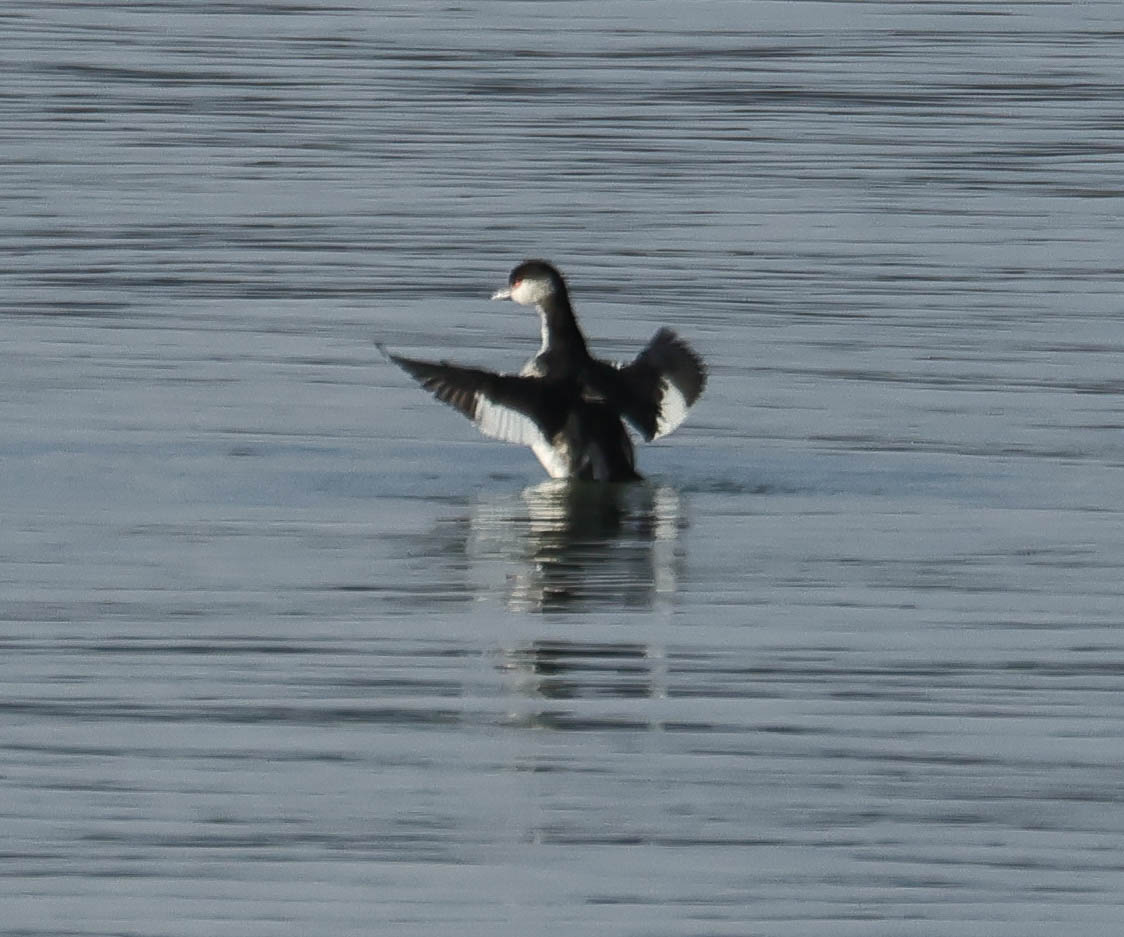
Slavonian Grebe: They are separable in flight or if they flap their wings, as the white is restricted to the secondaries on Slavonian Grebes, but the white continues onto most of the primaries on Black-necked Grebes. But this isn't a particularly useful feature when they won't fly at Studland & they are mainly nocturnal migrants
Slavonian Grebe: Another wing shot
Finally, a Black-necked Grebe for comparison which shows the peak of the head is above the eye, the black clearly curving below & behind the eye with the black fading into the white facial pattern and a thinner bill. They always look like large Dabchicks to me with shorter looking bodies and proportionally thinner necks, whereas, Slavonian Grebes look like small Great Crested Grebes, with longer bodies, proportionally thicker necks, a lower crown, the black curving up behind the eye before turning down with a cleaner-cut facial pattern & thicker bills.
Black-necked Grebe: Jerry's Point (10 Jan 22)

21 Nov 2014

21 Nov 14 - The Channel Islands Scrub Jay & Fox

There was no time to lose to start looking for an Island Scrub Jay once I got off the boat at Santa Cruz Island, as I only had about three & a half hours to look around Prisoners Harbour. One of the crew on the boat had said that Birders had seen the Island Scrub Jay on the coastal trail to the right of the valley. Island Scrub Jays are restricted to Santa Cruz and the current population size is thought to be about 2300 individuals on this twenty by five miles island. After a few minutes I reached the start of the trail & was heading uphill. After about twenty or thirty minutes of looking, I found the first couple of Island Scrub Jays. The views were fine, but they weren't particularly close. Fairly quickly they headed off & away from the path. I carried on Birding, but didn't see any others. The trail was getting more open & didn't look as suitable so I turned around & headed back to the quayside area. Here I ran into another, more showy, individual feeding on an acorn stash in a tree. Apparently, they harvest & hide acorns, so presumably this stash belongs to the Island Scrub Jay, rather than to an Acorn Woodpecker which also occurs on the island.
The hillside behind Prisoners Harbour: The mainland can be seen in the distance
Fire is a real risk for the wildlife on the island as it is so dry
Looking along the coast
Island Scrub Jay: They are restricted to Santa Cruz Island
Island Scrub Jay: They were split from Western Scrub Jay by Clements & IOC, however, BWP still regards Island Scrub Jay as a subspecies of Western Scrub Jay
Island Scrub Jay: They are about one third larger than Western Scrub Jays
Island Scrub Jay: It has pulled an acorn out of a hole
Island Scrub Jay
Island Scrub Jay: The acorn was swallowed whole
Island Scrub Jay: It was a great looking Jay & my only Tick of my short stopover in California
It was time to find some shade & eat the small snack I had brought over with me. However, this was quickly disturbed by the appearance of an Island Fox which appeared to have a look around the landing area. It was clearly used to people & presumably was hoping I had brought some food for it. I hadn't & it wouldn't be a good idea to feed an endemic species with a limited range. Island Foxes are distantly descended from the mainland Grey Fox, however, they are regarded as a separate species. They are found on six of the eight islands with each island having its own distinctive subspecies. Like many island species, they have become a lot smaller than than mainland ancestor which is probably an adaptation to the limited food availability on the island. However, they also wouldn't need to be as large to compete with other predators, as Grey Foxes on the mainland need to. Their head & body length is around nineteen inches with another eleven inches for the tail. This compares with Grey Foxes which range in size between thirty & forty four inches for the head & body length and a tail ranging from eleven to seventeen inches in size. The overall population is currently around 6000 individuals. In the 1990s introduced Cats, Pigs, Sheep, Goats & Red Deer had all been removed. However, about this time Golden Eagles were becoming commoner on the islands & they became a significant predator for Island Foxes. In the late 90s, canine distemper arrived on the island & this killed over 90% of the Island Foxes on St Catalina island. Similar crashes were seen in most of the other island populations with the number on Santa Cruz being reduced to 135 in 2000, from a population of 2000 only six years earlier. Fortunately, following a program of vaccination for distemper & rabies and captive breeding programs on some islands, the populations have now recovered to their former numbers. Visitors are no longer allowed to bring their pets to this island which might have been how the distemper was originally introduced.
Island Fox: This is a really cute Fox
Island Fox: The current population on Santa Cruz is around 1750 individuals
Island Fox
Island Fox
I still had another hour before I needed to return to the quayside so I had a look around the bushes in the valley. It isn't possible to walk too far up the valley, as a fence indicated it was private property.
The valley behind Prisoners Harbour
It was private land beyond this fence
There was a selection of Birds in the bushes close to the landing area, so I was happy to not wander too far.
Hermit Thrush
Ruby-crowned Kinglet
Loggerhead Shrike: This individual was hanging around close to the quayside
Song Sparrow: This is the graminea subspecies which is restricted to the Channel Islands
Song Sparrow
Spotted Towhee
Finally, it was time to wander back to the quayside where there were some Gulls to photograph.
California Gull: There were a few loafing around on the pier. The black band & red spot on the bill & the dark eye all help to identify them from the other local species
Heermann's Gull
The Island Packers boat
We had the waves behind us on the journey back & it wasn't quite as rough as it was on the way over, but it was still pretty bouncy. There were good numbers of Cassin's Auklets, a few Fulmars & Black-vented Shearwaters, Pelagic Cormorants and a large feeding party of around 150 Western Grebes. There was also a couple of Short-beaked Common Dolphins which is the most abundant Dolphin on this stretch of the Californian coastline.
Fulmar: The Pacific rodgersii subspecies of Fulmar look very different colouration from their North Atlantic cousins
Common Seal: Another familiar face was a Common Seal as we were close to Ventura Harbour
We were back in Ventura harbour in late afternoon. Some of the Black-necked Grebes were still happily feeding in the main channel.
Black-necked Grebe
Ventura Harbour is a long channel
Another view of Ventura Harbour
Once I was back on dry land, there wasn't a lot of time left to go far. I headed out of town & found a convenient beach to have a final look around. The light was fading fast & there wasn't much I could do other than watch the sun going down. Next, it was back to the harbour area for some food, before heading off for a few hours of driving to my next & final location.
Sunset over the Channel Islands: It has been a good day with the Island Scrub Jay seen & a bonus Island Fox