7 Sept 2014

7 Sep 14 - A Great Heron On The Patch

As mentioned in the Roesel's Bush Cricket post, I have just managed to find a good bird at Middlebere. I had gone out for the early morning high tide in the hope of Little Stint or Curlew Sandpiper being pushed up in front of the hide. Little Stint would be a Middlebere Tick & I've only seen Curlew Sandpipers there on 5 occasions, involving a total of 7 individuals. Most end up visiting Brownsea & staying there until they leave Poole Harbour. But with both species being recently seen on Brownsea & also slumming it Lytchett Bay, then there is always a chance. But neither turned up today. But there were a few other interesting birds seen which I will cover in another post, as I haven't got the time to edit those photos today. As I was walking back up the track, I thought I would have a quick look in the other Northern arm of the Wytch Channel as that is also visible from the Middlebere area. There is a hide, but like most visitors I rarely visit it as the channel is normally very quiet. Instead, I decided to scan from the far end of the channel, rather than look from the hide. There was a mass of Canada Geese & standing among them a Great White Egret. Wow: Great White Egrets are really elusive in Poole Harbour & rarely seem to be seen by reliable Birders.
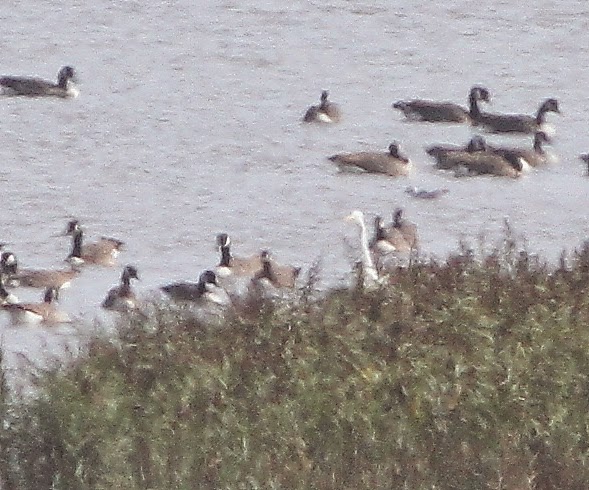
Great White Egret: Not a great shot, but I needed a record shot as it would take a few minutes to get to the hide & I wasn't going to wait then for a photo as that would be its cue to depart. The orange bill, size & ungainly neck shape are just about apparent
I quickly got to the hide to find a couple of visitors there. I quickly asked it the Egret was still there & was met with surprise I knew about it, until I explained I had been watching it from the other end of the channel. Then it was time to grab a few more shots & phone the news out more widely. Although the first phone calls had begun from the end of the channel.
Great White Egret: Note, the long kinked neck, long & thick orange bill & black legs
This is only my second Poole Harbour GWE, after finally seeing the first on 18 May this year after several hours staking out the Wareham Channel from the late afternoon to the evening. That individual had finally shown itself after a 4.5 hours vigil, when it flew towards Arne from the Piddle valley, about 30 minutes before dusk. It had been my 10th attempt of looking for that ultra elusive bird.
Great White Egret: Oh look, it's got 2 babies with it! The size comparison against these Little Egrets shows how large they are
The bird I saw in May had been hanging around from early Winter to about mid June this year & which was only reliably seen on about 10 occasions in that period: it seemed to be feeding up the Frome & Piddle valleys & flying into the harbour to roost. There are plenty of other reports of Great White Egrets, as this seems to be the most strung species in Poole Harbour for inexperienced Birders (I guess a good record from an inexperienced birder does occasionally get overlooked). Then after a couple of months of no sightings, local Birder Graham Armstrong saw one at South Haven on 15 Aug. It flew out of the South Haven pool, but Graham saw it again an hour later in the same area, after which it disappeared for good. Graham & I have both spent a fair bit of time around Studland trying to relocate it over the last couple of weeks, but I assumed it had quickly moved on out Poole Harbour as they just don't stick around: about 5 minutes would be a long observation in the Harbour. So I was really shocked to find this Bird. It stayed around till about 14:30 (3 hours after being initially found) when it walked out of sight at the bottom end of the channel: as the tide had dropped a long way. I was due to do the monthly WeBS count of the lower channel at 15:30, but it sounds like it flew off some time before I arrived. A real shame as it would have been great to see it on my WeBS count. But it was seen by Durwyn Liley flying over his WeBS sector in the direction of Studland. It was also seen by Jon Bellamy at Littlesea, Studland while he was doing his WeBS count. This was suddenly more tantalising as it was now back on my Studland patch. I spent an hour looking around Studland without any success that evening.

7 Sep 14 - A Stunning Bush Cricket

One of the interesting thing about some of the Bush Crickets in Dorset is the significant changes to some of their populations in Dorset. One of the most interesting is Roesel's Bush Cricket. For many years, this species was restricted to the the South East with isolated colonies at Needs Ore in Hampshire & the Dovey Estuary in Cardiganshire. Then for some reason in the 1990s, it suddenly started to expand its range in the Thames Estuary & started moving West. The Dorset range extension is well documented in the excellent Grasshoppers, Bush Crickets and Allies book which was recently published in 2011. The first Dorset record was in 2005. Since then it has steadily moved West through the Bournemouth & Poole conurbations and carried along some of the river valleys, especially the Avon, Stour & Piddle valleys. I thought I had photographed one at Alner's Gorse last Autumn, but thanks to Michael Skelton this has now been re-identified as a Dark Bush Cricket. They have been found this Autumn around Portesham, which is only about 20 miles from the Devon border: another impressive range extension.
Dark Bush Cricket: Female. I had through this was a Roesel's Bush Cricket, but thanks to Michael Skelton (see Comments), I've been corrected. It does explain why it wasn't well marked for a Roesel's Bush Cricket. I had assumed that was down to it being the equivalent of the teneral phase similar to the teneral phase seen in Dragonflies, where the freshly emerged adults are dull compared to the mature adults. Clearly, an identification error was a better explanation. Alner's Gorse (Aug 13)
I've been trying to photograph some more & have been out looking at a few sites in the Poole area as well as along the Jurassic Coastline. But the weather wasn't ideal on the days I was out looking for them. What has been slightly frustrating is despite listening to recordings of the call, I've not managed to hear any. But my mate, Kevin Lane, has been hearing them at various places in the Purbeck area recently. Although I'm able to pick out other calling species, I'm just wondering if I'm starting to struggle at the frequency that they call. Anyway, I ran into Kevin at Middlebere today as I found a good bird there today. But that will have to be the subject of tomorrow's post as I will have more time to look at the photos tomorrow. But to return the favour, Kevin asked if I had see any Roesel's Bush Crickets yet, as he had heard some nearby.  As I hadn't, I joined him on a quick look & he quickly found a calling individual, which I could just about hear. It didn't take him long to find it & it was a really well marked individual.
Roesel's Bush Cricket: Male. Note, the broad yellow edge to the side plate of the black pronotum and the 3 yellow spots to the side of the abdomen. Turns out this was a Tick for me

6 Sept 2014

6 Sep 14 - Lady's Of The Autumn

I'm never been particularly excited about Flowers & when I've expanded my horizons beyond Birds, Butterflies & Amphibians (the latter two I got into even before Birds), I have preferred to look at Mammals & other Insect groups. Basically, I prefer things that move. There are a few exceptions in the Flower world that I have spent some time photographing, primarily Orchids & Sundews. At this time of the year, the Spring & Summer Orchids are more or less finished & then when you think it's all over, Autumn Lady's Tresses start appearing. They are easy to overlook, being no more than 3 or 4 inches high & that's the biggest ones. This is a species that really likes short grassland & the best thing is they like Birding sites. I first saw them at Dungeness around the moat at the end of Aug 1980. Since moving to Dorset, I've seen them in a number of Autumns, around Durlston, Winspit, St Aldhelms & Chapmans Pool. A few days ago, Graham Armstrong mentioned he had found them at Greenlands Farm & that was a good excuse to have a look around the Greenlands Farm part of the Studland patch.
Autumn Lady's Tresses: Greenlands Farm. There are just over 100 in a small patch (6 Sep 14)
The following day was the WeBS count. I check the Wytch channel from private fields on Fitzworth. Whilst walking up to my viewpoint, I found a few Autumn Lady's Tresses in the cow field. As I walked back, after completing the count, I ran into a larger patch of 40 within about a 10 metre radius of where I was standing. At this point, I rang Kevin Lane, who does the adjacent Fitzworth/Ower sector, who joined me as his count was over. We stopped counting when we passed 200 stalks & had still only covered a small percentage of the field. If the density was uniform across the field, there would be a few thouand in that field alone. Given there are several other equally similar looking fields nearby, the chances are these fields support a really good colony of Autumn Lady's Tresses. Unfortunately, these fields are strictly private, but they do occur at Durlston & I'm sure the Durlston rangers won't mind pointing interested visitors in the right direction to see them there.
Autumn Lady's Tresses: Fitzworth (7 Sep 14)

4 Sept 2014

4 Sep 14 - Catching Up - The Best Of The Rest From Old Harry

I've made a number of visits to Old Harry, whixh is part of the Studland patch this month. Some of the photos from these trips have made it into Spotted Flycatcher, Pied Flycatcher & Redstart posts already, but other photos haven't. So I'll take this opportunity to catch up on some of the other birds seen in early Sep around Old Harry. Nothing particularly rare, but all of which keep the interest up whilst hoping for that good Bird. Three of these are new species for the blog. That's the point I ran out of time for blog preparation today. Will aim to get some more out tomorrow.
Sparrowhawk: Old Harry (4 Sep 14)
Peregrine: A fleeting flying over bird which is often encountered around Old Harry (3 Sep 14)
Wren: Old Harry (3 Sep 14)
Dunnock: A generally overlooked species, but a favourite of mine as they are great characters. Old Harry (3 Sep 14)
Whitethroat: These have been a few around on most visits to Old Harry, so far this month (4 Sep 14)
Robin: Adult. Surprisingly, the first photo of Robin for the blog. Old Harry (4 Sep 14)
Robin: Juvenile. Old Harry (4 Sep 14)

4 Sep 14 - Obliging Spotted Flycatchers

I wasn't overly happy about the Spotted Flycatcher photos in the Studland churchyard yesterday, as they were all a bit overexposed. With the focus point set to smallest point on the Canon 7D and the exposure set to normal, they were all coming out as over exposed. This was a combination of the bright sun reflecting off the white breast & the darker backgrounds. So I was glad to find 3 more Spotted Flycatchers on the walk out to Old Harry on the following morning, as well as finding the Studland church flock had increased to 7. So a chance to get some better photos and I came happy with some of these photos.
Spotted Flycatcher: One of 3 birds near the start of the track to Old Harry. Note, the long wings, narrow wing edgings & narrow wing bar. Also, note the long whiskers
Spotted Flycatcher: Yesterday, I wondered if the Spotted Flycatchers in the church had arrived on the Old Harry headland & then moved inland to the church or dropped in from the Vis Mig flyway which goes over the village. I guess this supports the former theory
Spotted Flycatcher: There was another fairly obliging bird in the churchyard, but it just wouldn't let me get as close as the Old Harry bird
Spotted Flycatcher: In a few weeks, this bird is likely to be on its Sub-Saharan wintering grounds, which lie South of a line from Senegal to Kenya. They can winter as far South as South Africa

3 Sept 2014

3 Sep 14 - Churchyard Redstarts

As well as the Pied Flycatcher & Spotted Flycatchers in the Studland churchyard, there were also 3 Redstarts. While this number wouldn't be that unusual at Durlston or Portland or occasionally on a good day at the nearby Old Harry, I have never seen more than a single Redstart in the Studland churchyard & even then only on a few occasions. So finding 3 individuals feeding in the church was noteworthy & an opportunity for plenty of photos.
Redstart: With a Chiffchaff trying to get noticed. I assume this Redstart is a female
Redstart: Showing the red tail base & outer tail feathers, which gives them their name
Redstart: Male. The Redstarts liked to feed from the gravestones when it was quiet. The third Redstart was a less well marked male, but I failed to get any photos of that individual
Redstart: Male. Signs of a male plumage are coming through on this individual
Restart: Male. In a few weeks this is likely to be on the wintering grounds in Sub-Saharan African: which stretches in a band from Senegal to Western Kenya & Ethiopia. Hopefully, it will make it back to breed next Spring

3 Sep 14 - Flycatcher Fun In The Churchyard

Back in the Spring, I put a post together about one of Dorset's most impressive soldiers, Sergeant William Lawrence, who fought through the whole of the Peninsula War & continued to survive his final battle at Waterloo, before returning to Dorset & running a pub in Studland. I finished the post, pointing out that the churchyard can be a migrant trap on the right day & Spotted Flycatchers are one of the more interesting regular species that occur. Well today, it proved to be the best part of a visit to Old Harry, which always starts in Studland village. Overall, Old Harry was fairly quiet today, with a scattering of typical migrant Warblers (Blackcaps, Whitethroats, Willow Warblers & Chiffchaffs) and a couple of Redstarts. Scarcest bird was a Reed Warbler: an erratic migrant here. 5 Clouded Yellows were the best of the bunch on the Butterfly side.
Clouded Yellow: Colour overload with the mainly unripened Blackberries
Having got back to the Studland car park, there was time for another quick look in the churchyard. It had been pretty quiet on the early morning visit, but it's not unusual for Flycatchers, & later in the year Black Redstarts, to arrive later in the morning. Guess they are either drifted off the Ballard Down/Old Harry headland having arrived that morning or dropping in whilst on Visible Migration. The church lies on the Vis Mig route which runs from the Poole Harbour mouth, to Studland & Durlston (or the reverse direction depending on which way Birds are moving). So I wasn't too surprised when I saw a couple of Spotted Flycatchers, which quickly increased to at least 4 after a bit more looking.
Spotted Flycatcher: The first greeted me on the church fence
I settled down to try & get some better photos of the Spotted Flycatchers as the sun was pleasantly warm & it was easily the best day for a couple of weeks.
Spotted Flycatcher: Note, the streaky breast & crown
Spotted Flycatcher: A typical date right in the middle of their main migration period through Studland
Spotted Flycatcher: Note, the narrow pale edges to the tertials and the pale tips to the greater & median coverts which form the 2 narrow wing bars. Also note, how long the wings are. They are quite obvious in flight, due to the wing length
Spotted Flycatcher: Just spotted another meal
Finally, I was pleased to see the Spotted Flycatchers were joined by a Pied Flycatcher. This was working a different patch of trees from the Spotted Flycatchers, but was sometimes coming into the trees, where the Spotted Flycatchers were feeding. It's only my 7th Pied Flycatcher for the Studland/Ballard patch. But the third in the churchyard & with one is the adjacent field next to the hotel, it's clearly the best local place to find them. It's perhaps not surprisingly they are less common in the Studland area, as most of the local Pied Flycatchers seem to end up on the Jurassic coast from Durlston to Winspit/St Aldhelms. It would help if I chose a patch with a South facing coastline, but then the whole point of patch Birding is to have your own patch, as well as making it harder for yourself. But overall the Studland/Ballard patch does get the highest patch species list locally, with my personal best year list of  177 in 2009. So I can't complain too much.
Pied Flycatcher: They are slightly smaller & more compact than Spotted Flycatchers, with unstreaked breasts & crowns
Pied Flycatcher:Note, the broad white edges to the tertials, the darker, unstreaked chocolate upperparts & stronger white greater coverts wing bar and just a hint of a median coverts wing bar
Looking at the photos, I think I should be able to get better photos, so there is a good excuse to try again.