24 May 2014

24 May 14 - Swivel-eyed Loon Added To The IQ40 UK List

In a surprise announcement, the IQ40 club have added the Swivel-eyed Loon Gavia fruitcakei, (also known as the Swivel-eyed Diver), to the IQ40 UK List. A spokesman from the IQ40 club confirmed the Swivel-eyed Loon has been identified at a number of localities in the Home Counties. Other ornithologists have expressed concern that that the population seems to consist of elderly individuals which are not believed to have bred for many years & questioned whether the population is self sustaining in the long term. However, the IQ40 club spokesman said there are more of these in the Home Counties now than Lady Amherst's Pheasants and we still allow Lady A's to be ticked on our popular tours.
Great Northern Diver: These are clearly not Swivel-eyed Loons, which are know to only lean to the right
A spokesman from UKIQP, the political wing of the IQ40 club, commented "We broadly welcome these changes as this is our party's logo and the distinctive purple colour looks great on the Swivel-eyed Loon". We are pleased with the number of records that have been recorded all across the UK during the European Big Bird Count yesterday.
White-tailed Sea-eagle: This is turning up regularly in England these days & therefore not a troublesome species in the event of Scottish independence (Rum 1 Nov 13)
Speaking more generally, both the UKIQP and the IQ40 club spokesmen strongly supported the campaign for Scotland to remain part of the UK. Should Scotland vote for independence, then funding will be found to relocate key UK species such as Capercaillie, Crested Tit and Ptarmigan to the Lake District, saying it's important that we are allowed to continue to tick these birds on our Year Lists.  As for the so called Scottish Crossbills, the IQ40 spokesman added, we don't recognise that species as they are too hard to identify, so they can keep them. We would strongly support all plans to retain the Hebrides, Orkneys, Shetlands and Fair Isle as part of the UK, should Scotland vote for independence. 
Corn Crake: A reintroduction scheme into the Fens has already made this species cheaper to Year tick in these days of soaring fuel costs. It's hoped relocating the Capercaillie, Crested Tit and Ptarmigan further South will reduce the UK's dependency on Shetlands oil (Balranald, North Uist, 4 June 12)
When asked about two recent controversial birds, the IQ40 spokesman confirmed that the Flamborough Atlas Flycatcher will remain fully tickable (following scientific studies that showed that its DNA was indistinguishable from that of a Pied Flycatcher). Thus, it is completely tickable alongside the UK Pied Flycatcher.
"Atlas Flycatcher": Well OK, this is a Collared Flycatcher, but they all look the same, give or take a bit of black & white here & there (Beit Yatir, Israel 8 April 14) 
The IQ40 spokesman also confirmed the current Hampshire male Italian Sparrow is fully tickable, as scientific studies are also expected to show a high percentage of House Sparrow genes in it (when a DNA sample can be obtained). He added (desperately), I've already travelled to see it & I can't lose this bird off my Year list. Cynics have said the Italian Sparrow looks a bit like a cross between the following two species (perhaps that explains it). 
Spanish Sparrow: (km19 - km20, Eliat, Israel 9 April 14)
House Sparrow: (Jungle Hut, Western Ghats, India 28 Dec 13)

18 May 2014

18 May 14 - Hawk Watching

With a few days of warm, sunny weather, it was the right time of year to go out Hawk Watching locally. I wasn't looking for a migrating Red Kite: we now have a small, but regular, Easterly movement of Red Kites through coastal Dorset on fine Spring days. I've assumed these are part of the reintroduced birds from the Home Counties, some of which I suspect migrate to the South West of the UK to Winter, before returning to their breeding sites in the Spring. Neither am I looking for a Honey Buzzard or Montagu's Harrier, which are even scarcer migrant Hawks which might be seen arriving in the UK at this time of year. No I'm thinking of a much smaller Hawk, Narrow-bordered Bee Hawk Moth. Like the Broad-bordered Bee Hawk Moth, they are on the wing in May to July in Dorset. They are most likely to be encountered at chalky sites in Dorset & their favourite foodplants are Devil's Bit Scabious, Small Scabious & Field Scabious. Broad-bordered Bee Hawk Moths foodplants are Honeysuckle & Bedstraw & they seem to prefer areas around the Dorset Heaths. One of the best places to look is Powerstock Common. I had been there the previous day, but I didn't have good directions to some of the best areas. With better directions, I decided to try again while the weather was good.
Marsh Fritillary: This was the only one I saw on the wing
Wall
Grizzled Skipper
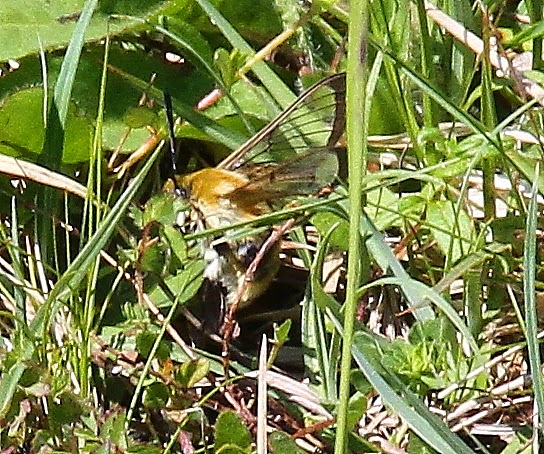
Narrow-bordered Bee Hawk Moth: Think this is a female as I followed her around appearing to lay eggs
Narrow-bordered Bee Hawk Moth: I couldn't resist another photo as most views were of them belting across the Downland field like a high speed, straight flying Bee, before disappearing back up into the surrounding trees
Narrow-bordered Bee Hawk Moth: A final photo showing the great face pattern
Pyrausta purpuralis: A fairly common downland day time flying moth
Twayblade: This is a fairly common chalk downland Orchid in Dorset & Hants
Twayblade: Another shot of the flowers
Bugle: One of the more popular flowers for the local Butterflies & Moths
I took a different route back from Powerstock which gave me the opportunity for some more great views over this stunning part of the county.
Eggardon Hill Fort: This impressive Iron Age fort about 2,500 years old & is partly owned by the National Trust & partly privately owned
On the way home, it was such a warm, sunny afternoon, that I decided to have a look for an ultra elusive Great White Egret in Poole Harbour. This bird seems to roost in Poole Harbour & has been seen flying up & down the Frome Valley at varying times of day. There is no real pattern, other than it seems to roost in the Harbour & feed outside the area. After trying all my usual viewpoints over the Lower Frome Valley, I headed to a viewpoint inside Poole Harbour with a plan to stick it out to dusk to see if it flew in. 4.5 hours later as it was cooling down, I was beginning to regret not taking more clothing with me. But all that changed when I picked up the Great White Egret flying from the Upper Piddle Valley & heading towards the Arne Peninsula. My view as it got to Arne was blocked by trees so I couldn't see how far it went. Still I had managed to finally see it, after about 10 attempts over the past few months to find it feeding in the Lower Frome Valley. Perhaps part of the reason I was missing it, was as it was also feeding in the Lower Piddle Valley. But some mornings, it had been seen flying up the Frome. A long wished for Poole Harbour tick & probably only about the 10th reliable sighting by local Harbour birders, of a bird that's been around for several months.
Hairy Dragonfly: Female. I saw this fly around, catch a large insect eat it & then fall asleep. If only the GWE had been so straight-forward to watch it go to roost

17 May 2014

17 May 14 - Going Back In Time

Last year I planned to visit Powerstock Common in May, a great downland reserve to the North West of Dorchester, to look for Narrow-bordered Bee Hawk Moth. However, circumstances stopped me getting there last year. This year the spell of warm, sunny weather in mid May tempted me. Powerstock is a Dorset Wildlife Trust reserve & takes visitors back to a period when there were better numbers of Flowers, Butterflies, Bees & other insects in the countryside. It's a great reserve to visit. The main area I was focusing on was the disused railway line where the track has been removed and the track & the banks are now managed for Flowers, Butterflies Bees & other insects.
The disused railway line: Looks really good habitat, doesn't it
The disused railway line: Further along the banks start to widen out
I spent my time looking along the railway cutting, but keeping to the bottom. Turns out I should have been looking higher up on the South facing slope, but I wasn't aware of that at the time.
Small Heath
Grizzled Skipper: I saw 3 Grizzled Skippers on the visit
Dingy Skipper: There were at least 8 Dingy Skippers flying around close to the base of the gully
Pyrausta despicata: This small Moth is widespread in downland & limestone habitats & is a common diurnal species
It's not just the Butterflies that the habitat is managed for, but also the flowers, as if the DWT don't get the flowers right, then there won't be the food plants for the caterpillars to eat.
Cowslip: One of my favourite downland flowers
I found this great view as I was heading back in the direction of Maiden Newton from Powerstock Common
As I reached Corfe Castle, I passed a steam train on the Corfe Castle to Swanage heritage line heading to Swanage. I frequently see them, but rarely have the camera so I had to stop this time. There are frequently people photographing the trains from this bridge, but today I had it to myself. Just two of the local tourist attractions I rarely stop to enjoy & which I would do more often, if not distracted by the local Birds & other wildlife.
Eddystone steam train: It's on it's way to Swanage, with Corfe Castle in the background
Eddystone steam train: I like the juxtaposition of the old & the very old. The Eddystone is one of the regular steam trains on the heritage line

14 May 2014

14 May 14 - Family Photo Tick

In the Centennial Postings Part 1 & Part 2, I promised you I would start to add to the 84 families of birds I had already managed to photograph with the new Canon camera. That total ignored a few additional families of Birds that I had already photographed with my little Lumix, a video camera & quite a few more families with the old fashioned cameras that used film (young readers ask your parents about this, but stop listening if they start rambling on about the good old days). But I'm not going to count any of these families, as the quality of those photos is generally pretty average compared to the Canon. Anyway, if you can't stand the suspense of wondering what the family photo tick is, then go to the end now (as I've doing this post in order of the day's activities).
Common Frog: They are non breeding visitors in my ponds & haven't been very regular this year
After a few warm, sunny days, the birding was pretty quiet & I decided to switch to looking at insects. Last year while out at Studland looking for Downy Emerald & Hairy Dragonfly at this time of year, I found a Broad-bordered Bee Hawk Moth. So it seemed a good idea to try & see if I could find some more as well as look for Butterflies & Dragonflies.
Holly Blue
Wall: A bit tatty, but it was the only once I saw in a couple of hours of looking
Downy Emerald: This appeared on the Rhododendron on a couple of occasions. I really like their bronzy-green colouration
Four-spotted Chaser: The dark spots in the middle of leading edge of each wing is diagnostic
As for the Broad-bordered Bee Hawk Moth. It would appear for about 20 - 30 seconds with 5 sightings in total. Each time it flew around like a cross between a Hummingbird Hawk Moth & a Bumblebee, briefly stopping on a flower to grab some nectar, before disappearing out of my field of view again for another 15 minutes. I failed to get any photos, so here are last year's efforts with my Lumix.
Broad-bordered Bee Hawk Moth: A photo of last year's individual, as I've failed to get a photo after several attempts this year (2 June 13)
Broad-bordered Bee Hawk Moth: Another shot (2 June 13)
The final stop was the Studland churchyard, hoping for a migrant or two to be lingering there. No joy, but did get the family photo tick: an adult & recently fledged juvenile Dunnock. Dunnocks are the only regular member of the Accentors family in the UK, although there are also 45 accepted records of Alpine Accentor in the UK to date. I suspect many UK birders ignore looking at Dunnocks, but the birds in my garden are usually feeding very close to the kitchen, even more now since I installed several feeders there. As a result, I get to see them close up daily & they are full of character. Recently, the male is displaying & I'm also seeing begging actions from the female, as they are preparing to breed again (sexed based upon behaviour). I've also got a young bird from their first brood feeding regularly as well. Despite having only appeared in the last few days, it's very capable of feeding & looking after itself, although it's still a bit nervous & domineering compared to the very laid back adults.
Dunnock: Adult. The sexes are identical in plumage & aging them once the juveniles have lost their streaky juvenile plumage is very difficult (seem to remember there is a subtle difference in eye colour)
Dunnock: Juvenile
On the way back home, I spotted a sailing ship, the Royalist, which is a Marine Society & Sea Cadet sail training ship at mooring in Swanage Bay.
The Royalist sail training ship

12 May 2014

12 May 14 - All Quiet On The Western Front (Of Poole Harbour)

I've been visiting Middlebere quite a bit recently, but it's all been pretty quiet on recent visits. While still pretty quiet today, at least a few species were a bit closer than usual.
Little Egret: This has been commonest Heron in the Poole Harbour area for over a decade now
Little Egret 
Little Egret: It will take a lot of these incredible small morsels to stop a Little Egret from going hungry
Spoonbill: Immature with black wing tips. There are still up to 10 individuals that have been seen in Poole Harbour this month. All the birds I've seen have been immatures that haven't got around to heading back to the Dutch breeding site they were probably born in (based upon colour ringing schemes) 
Shelduck: Pair. The male on the right has a knob at the base of its bill. I'll leave you to do the cheap jokes
Blue Tit: The local Blue Tits are being kept busy trying to find food as this individual looks like its got chicks in a nearby nest. The British Isles has its own subspecies, obscurus

11 May 2014

11 May 14 - Centennial Post (Part 2) - My Best Passerine Photos

Part 2 of the centennial post: the best photo for each of the Passerine families that I've managed to photograph so far in the first 99 posts. But first a big thank you to everybody who is following the blog. So far over the first 100 posts, I've had over 15,000 hits to the blog & I'm generally averaging about 150 hits a day at the moment. I don't know how that compares to other people's blogs, but it seems pretty good to me, given the blog has been going for just over 6 months. It's quite surprising how many countries have people who have been looked the it & I've had hits from all the continents (I've excluded Antarctica as Google doesn't publish stats for there).

Coming soon will be the rest of the Israel trip where there are some more cracking photos yet to be published and this will be followed by a short trip to Croatia that I've just returned from. I've realised in these milestone posts, that I've now set myself a target to go out & photograph members of the missing families. There are a few common British families to photograph so look forward to exciting posts about Fulmars, Storm-petrels, Skuas, Barn Owls, Dippers, Dunnocks, Bearded Tits, Long-tailed Tits & Treecreepers. A British Wallcreeper would be very welcome as well. So there is plenty to look forward to in coming posts. I'm also going to aim to get over half of the families photographed for the 250 post milestone.
Pittas: Indian Pitta - Jungle Hut, Western Ghats, India (29 Dec 13)
Larks: Thick-billed Lark - Aoussard Road, Western Sahara (12 Feb 14)
Swallows: Brown-throated Sand Martin - Oued Massa, Morocco (14 Feb 14)
Wagtails & Pipits: Nilgiri Pipit - Ooty, Western Ghats, India (31 Dec 13)
Cuckoo-shrikes: Small Minivet - CEDO, Gujarat, India (20 Jan 14)
Bulbuls: Yellow-vented Bulbul - Ein Bokek, Israel (6 April 14)
Crests: Firecrest - Knoll Beach, Studland (13 Nov 13)
Leafbirds: Golden-fronted Leafbird - Jungle Hut, Western Ghats, India (29 Dec 13). The bird is feeding upside down
Ioras: Marshall's Iora - CEDO, Gujarat, India (19 Jan 14)
Hypocolius: Grey Hypocolius - CEDO, Gujarat, India (20 Jan 14)
Wrens: Wren - Rum (1 Nov 13)
Thrushes & Allies: Indian Blackbird - Ooty, Western Ghats, India (31 Dec 13)
Cisticolas & Allies: Cricket Longtail - Aoussard Road, Western Sahara (8 Feb 14)
Grassbirds & Allies: Grasshopper Warbler - Munnar, Western Ghats, India (8 Jan 14)
Reed Warblers & Allies: Clamorous Reed Warbler - CEDO, Gujarat, India (20 Jan 14)
Leaf Warblers: Sulphur-bellied Warbler - Mount Abu, Rajasthan, India (22 Jan 14)
Sylvids: African Desert Warbler - Aoussard Road, Western Sahara (8 Feb 14)
Old World Flycatchers: Desert Wheatear - CEDO, Gujarat, India (20 Jan 14)
Fantails: Spot-breasted Fantail - Mount Abu, Rajasthan, India (22 Jan 14)
Monarch Flycatchers: Asian Paradise-flycatcher - Chinnar, Western Ghats, India (3 Jan 14)
Laughingthrushes & Allies: Nilgiri Laughingthrush - Ooty, Western Ghats, India (30 Dec 13)
Ground Babblers & Allies: Puff-throated Babbler - Jungle Hut, Western Ghats, India (28 Dec 13)
Yuhinas, White-eyes & Allies: Oriental White-eye - Jungle Hut, Western Ghats, India (29 Dec 13)
Tits & Chickadees: White-naped Tit - CEDO, Gujarat, India (19 Jan 14)
Nuthatches: Indian Chestnut-bellied Nuthatch - Jungle Hut, Western Ghats, India (30 Dec 13)
Sunbirds & Spiderhunters: Little Spiderhunter - Thattekad, Western Ghats, India (5 Jan 14)
Flowerpeckers: Andaman Flowerpecker - Ghandi Park, Port Blair, Andamans, India (22 Dec 13). One of my favourite photos as this Andaman Flowerpecker fed very close to me for some time
Old World Orioles: Black-naped Oriole - Jirgatna, Andamans, India (23 Dec 13). While I have sharper Old World Orioles, I just like the composition in this one
Fairy-bluebirds: Asian Fairy-bluebird - Mount Harriet, Andamans, India (25 Dec 13)
Shrikes: Bay-backed Shrike - CEDO, Gujarat, India (19 Jan 14)
Vangas, Helmetshrikes & Allies: Common Woodshrike - CEDO, Gujarat, India (20 Jan 14)
Drongos: White-bellied Drongo - Mount Abu, Rajasthan, India (22 Jan 14)
Woodswallows: Ashy Woodswallow - Periyar, Western Ghats, India (10 Jan 14)
Crows, Jays & Magpies: Rufous Treepie - Mount Abu, Rajasthan, India (21 Jan 14)
Starlings: Asian Pied Myna - Salt Lake, Calcutta, India (19 Dec 13)
Old World Sparrows: Desert Sparrow - Aoussard Road, Western Sahara (8 Feb 14)
Weavers & Allies: Baya Weaver - Desert Coursers, Gujarat, India (17 Jan 14)
Waxbills & Allies: Green Avadavat - Mount Abu, Rajasthan, India (22 Jan 14)
Siskins, Crossbills & Allies: Siskin - Blashford Lakes (24 March 14)
New World Warblers: Cape May Warbler - Unst (29 Oct 13). One of my most memorable British twitches
Buntings & New World Sparrows: Grey-necked Bunting - Desert Coursers, Gujarat, India (17 Jan 14)
Longspurs & Snow Buntings: Snow Bunting - Rum (1 Nov 14)
I hope you have enjoyed these photos as much as I have. For many families, it was quite easy working out my favourite photograph, but some families were really hard to keep to a single photo.