13 Jun 2014

13 June 14 - A Brilliant Emerald Jewel

Two years ago, I looked for Brilliant Emerald Dragonflies on the Fleet Canal. However, I was right at the end of their flying period & had no luck. Therefore, as it's one of the Southern Dragonflies I've yet to see, I was keen to have another look for them. Having seen the first were flying at the Black Pond at Esher Common in Surrey, then that looked a good place to try. Two advantages over the first attempt, I was going at a good time when they were freshly emerged. Secondly, it was a pond & therefore it should be easier to find them, compared to a canal which had no end to the extent to potential habitat. They like to fly in shady areas, but also on sunny days. So with the weather forecast predicting good warm weather with sunshine & some cloud, the conditions were looking good.
The Black Pond on Esher Common
The Black Pond on Esher Common: The Brilliant Emerald was at the far end of this bank, patrolling over a small area of shallow water. Unfortunately, the many dog walkers seem to think it's essential to throw a stick into the pond at the near end then have their dog swim the length of the pond's edge & walk out where the Brilliant Emerald is patrolling. Thus flushing it for several minutes. Glad I went mid week as a sunny weekend day would have been near impossible due to disturbance by dogs & unimaginative dog owners
The first Dragonfly I saw was a Black-tailed Skimmer & there were several males flying around the edge of the lake.
Black-tailed Skimmer: Male. Another blue Chaser with the combination of a slim abdomen, the black end to the abdomen, yellow edges to the blue abdomen & no dark wing bases
Initially, there was no sign of any Brilliant Emeralds, but then an Emerald came along the edge of the lake a couple of times, but quickly disappeared. On the brief views I had seen it, I couldn't rule out the similar looking Downy Emerald. I had no further sightings in the next few minutes, so carried on to the end of the pond, where I saw the Emerald again flying low over the water. After a couple of minutes of not being able to get any worthwhile photographs, I switched to the binoculars & could see the distinctive green and yellow face pattern of a Brilliant Emerald: success. The sun then came out & it flew into a small patch of sunlight under the trees where I managed to get some flight shots.
Brilliant Emerald: Male. They are brighter & more metallic, but this is very subjective. But they have a flattened yellow U band across the top of the forehead that turns up at each end which Downy Emerald doesn't have
Brilliant Emerald: Male. A close up of the flattened yellow U. This was even more obvious when fully face on, but I was using the bins & not the camera at the time
Brilliant Emerald: Male. Females have a downward spike at the end of the abdomen. Note, the sides of the yellow U are even visible side on (in this photo)
With the new Dragonfly seen & photographed, there was a few minutes to photograph some of the other residents of the Black Pond.
Dabchick
Moorhen
Coot

12 Jun 2014

12 June 14 - Chasing The Chaser

This was my third visit to Holmebridge, just outside the edge of the Poole Harbour area, in the last 2 weeks. I've been hoping to see Scarce Chaser, but had no success so far. Perhaps they hadn't emerged & started flying on the earlier visits. So it was a case of third time lucky on this visit with a female seen first.
Scarce Chaser: Female. The dark central markings on the abdomen, vivid colouration & the dark wing base on the hind wing are all diagnostic for this species
Scarce Chaser: Male. The black end to the abdomen, lack of yellow-orange edges & dark base to the hind wings are diagnostic 
Scarce Chaser: Male
Hairy Dragonfly: Mating pair
Holmebridge is the site of the Civil War skirmish of Holmebridge. Wareham like most of the Dorset towns had come out on the Parliamentary side. However, the Purbeck area was divided as the nearby Corfe Castle, owned by the Bankes family, had sided with the King. Wareham changed hands on more than one occasion during the Civil War and it was recaptured by Parliamentary troops in November 1643. On 27 February 1644, a force of about 300 Parliamentary troops met 45 Royalists at the bridge. A five hours fight ensured and only ended, when additional Royalist reinforcements arrived. The Parliamentary forces retreated, leaving 40 soldiers dead along with 1 dead Royalist officer.
The old Holmebridge: The old bridge was stone topped with parapets, but the sides were removed during the war to allow tanks to cross. Brick was used to rebuild the top once a replacement Bailey bridge was added to allow tanks to cross the river
The new Holmebridge: This modern bridge was built in 1963 to replace the Bailey bridge

11 Jun 2014

11 June 14 - An Obliging Barn Owl

I have tried to photograph every species of Owl I've seen since getting the camera last October. All was going well up to Israel until I had a brief flight view of a Barn Owl on the kibbutz we stayed at on the last couple of days, which was too brief a view to get a photo. As Barn Owls are a separate family to Owls, I had still photographed all the Owls, but I had no photographs of the Barn Owls family. Well I'm back on track on both families again, following a very obliging Barn Owl which flew past on several occasions while I was out birding locally this evening. This is the first Barn Owl I've seen since the Israeli bird & it's another family photo tick as well.
Barn Owl: It surprised me when it flew past & I didn't have the camera set up to over expose the photo (so the Owl would be correctly exposed against the bright background). But not too bad in the circumstances
Barn Owl: My 90th Family Photo Tick since getting the camera. Glad in came past again as I was prepared this time, but pity it wasn't as close. But at least it's a better idea of its colouration
Barn Owl: I like the hunting posture
Barn Owl: After catching this Vole, it evaded the attentions of 2 Carrion Crows & a Magpie, before flying past to show me what it had caught. Looks like a Bank Vole to me
Barn Owl: What a great bird
Barn Owl: Couldn't resist another photo
Barn Owl: Finally, flying off into the sunset. Guess I had better end here

10 Jun 2014

10 June 14 - Sand Lizards

It's getting into the Summer doldrums for birds locally at the moment. But living in Dorset, there is never a quiet time, providing you are happy to look at other wildlife. There are so many diverse lowland habitats locally, which means providing the weather is OK, your always going to see something of interest. This would be even more true, if I could get interested in flowers, but I've never got beyond Orchid photography. But I've always had an interest in wildlife that moves, starting with Butterflies & Amphibians when I was a kid. Now I'm happy to look at most other groups, especially where there are good field guides to help me with identification. Today I had the chance to have a quick look at the DWT reserve at Higher Hyde today, near Bovington. This was my first visit, but it won't be my last. Near to the car park is a reasonable sized lake & hide (or should that be hyde?).
The Higher Hyde lake
This is only a short walk from the car park & en route there was this very showy male Broad-bodied Chaser.
Broad-bodied Chaser: Male. The broad body, yellow-orange edges & dark bases to the wing rule out the other Chasers
Following the Broad-bodied Chaser, I came across a great use for old tyres. I guess they heat up quickly being black.
Sand Lizard: Male. I had to get a new tyre recently for the car. It had various classifications of energy efficiency, water clearance, but I don't remember a Lizard rating
Sand Lizard: Female (au naturale)

10 June 14 - A Warm Welcome to Hungary

Welcome to Hungary: you are my 50th Country to visit the Blog. I've not managed to make it to Hungary yet, but my mate, John Wright, who I travelled around the Western Sahara & Morocco with has recently returned from leading a Birding & Mammals tour there. He saw a lot of good birds & Mammals and it has confirmed my wishes to visit Hungary at some point in the next few years.
What a great readership of the Blog
Three weeks ago I was looking at another Birding Blog & saw a really great flag counter. Looking at it, I realised it was free to download & install and about 30 minutes it was on my Blog. I enjoy looking at it, to see who the readers of this Blog are & I'm quite surprised about your geographical distribution around the world. Given the trip to India, then it's not too surprising that there will are readers with interests in Oriental Birding. Likewise, the trips to Western Sahara/Morocco & Israel will have added a number of readers from around the Western Palearctic. The New Zealand flag was easy to add: my Sister & family live there (Hi guys). But there is already a good spread of readers from around the world. It is heartening to see how many people around the world have an interest in Birds & other wildlife. I have been birding in 28 of the 50 countries & would like to get to visit as many of the remaining 22 at some stage where time, finances & visas allow. In case you're would like more details of where the readers are from: here are the 50 flags:-
These are the flags of countries that have read the Blog in the last 3 weeks
The first 25 flags
The next 25 flags
So a big thank you to everybody for reading the Blog. I hope you have enjoyed it & continue to return over the coming weeks & months.
 

9 Jun 2014

9 June 14 - A Pearl Collection

Despite a long day in the field yesterday, I couldn't resist getting out in the sunny conditions today. The target for the camera was Small Pearl-bordered Fritillary. This is sadly a scarce Butterfly in Dorset these days, but it's hanging on in a few locations. Sadly, the similar looking Pearl-bordered Fritillary, is now believed to be extinct in Dorset. I saw about 10 flying around on a sunny hillside of bracken, cut back brambles & rough grassland. They were tricky to follow as when they got up & flew, as they would typically cover 20 or 30 metres before dropping down again. They were moving too fast to keep up with by following them & were easy to lose once they got too far away. In the end, I found they were best followed with the bins and then approaching carefully once I had seen them settle. They were either settling on grass stems to sunbathe or on the white flowers of the brambles to feed.
The habitat didn't look particularly special: But it is clearly special more special than it looks
Small Pearl-bordered Fritillary 
Small Pearl-bordered Fritillary
Small Pearl-bordered Fritillary: They are best checked on the underside to separate them from the similar looking Pearl-bordered Fritillary. This is described on the UK Butterflies website & I suggest you have a look at their excelent website
July Belle: I saw a couple flying around in the hour I was there

8 Jun 2014

8 June 14 - Walking On Water

I seem to remember hearing a story about walking on water when I was a kid. Well this is nothing remarkable for the UK's largest Spider, the Raft Spider, which will have been doing it in the UK since the end of the Ice Age. The local RSPB Arne reserve is a good place to see them, but I've had no luck when I've looked in the past. A warm, sunny day seemed a good idea to have another attempt. Also I knew there would a good selection of Dragonflies to photograph. Given it's Heathland, then there is also less grass to set off another hay fever attack.
The Dragonfly pool on Coombe Heath
Raft Spider: Female. The body is just under an inch long with a leg span of almost 3 inches. This one was at the back of one of the pools near the Shipstal hide 
Raft Spider: Female. The other UK Raft Spider is Fen Raft Spider which occurs in a few Fenland sites
I ran into a large party of Long-tailed Tits, which must have been a couple of successful family parties given the number of calling birds in the trees. The youngsters doing their best to out-compete their siblings in the demands for food.
Long-tailed Tit: Adult with a youngster behind adds another family photo tick to the list
Migrant Butterflies were represented by a fly past Clouded Yellow: my first for the year & 3 Painted Ladies.
Painted Lady
There was a good selection of Dragonflies on the pools at Arne.
Emperor Dragonfly: They were spending hours hawking over the pools without stopping. This shot shows the typical large bulky body
Emperor Dragonfly:Female egg laying
Four-spotted Dragonfly: The spots in the middle of the leading edge of each wing identifies this as a Four-spotted Chaser
Azure Damselfly
Perhaps the most surprising event of the day was watching something swim across one of the pools. I got some photos and then as it got to the far side & sat on a convenient reed in the water, I checked in with the scope & realised it was a Lizard. I didn't appreciate they could swim, but it seemed to be doing a good job at it.
Common Lizard: Female. It looked like swimming was something this female had done before 
Common Lizard: Female. She was too heavy to walk on the water
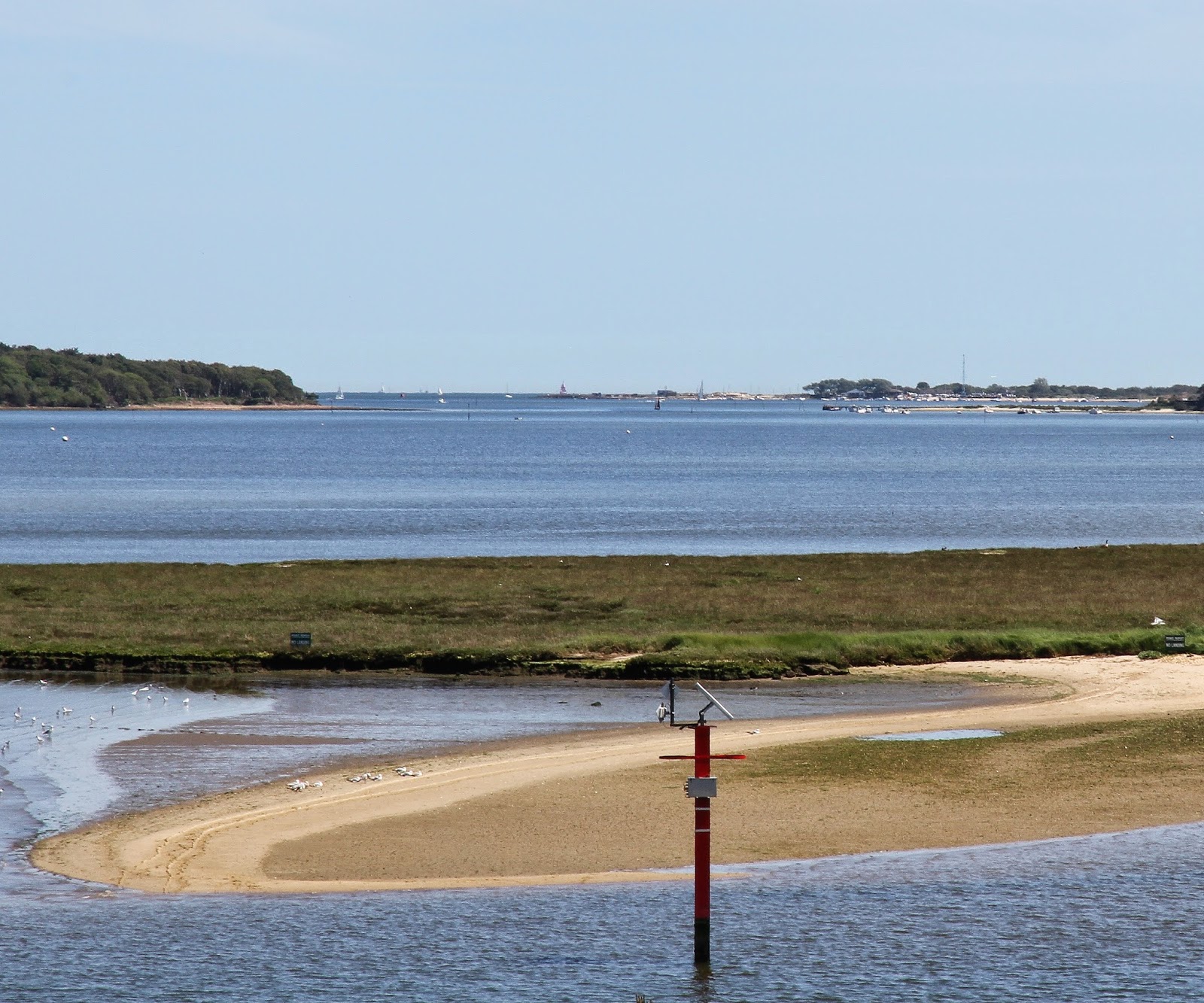
The RSPB Arne reserve sits on a large heathland peninsula which sticks out into the Western end of Poole Harbour. It separates the Wareham Channel from the rest of the Harbour. I don't tend to go there that much, as I end up driving past Studland, Rempstone Forest & Middlebere and one of those sites will generally convince me to stop. But there are great views overlooking Poole Harbour from Arne's Shipstal Point.
Looking towards the Harbour mouth
Looking a little further left is Brownsea
Poole town quay is just across the water
Looking up the Wytch (left) & Middlebere (right) channels