24 Oct 2023

24 Oct 23 - Happy Tenth Birthday

It's ten years ago since I decided to buy a decent digital camera. My mate Pete Moore recommended I bought a Canon 7D & 400 mm lens. Pete also helped me get up to speed on the best settings for this combination. My first trip out was eventful as I was photographing a Kingfisher at Middlebere, when news broke about a Pallid Swift at Christchurch. I ended up getting thrown in at the deep end with trying to photograph a Pallid Swift in flight that afternoon. This was my first Blog Post.
Pallid Swift: This Pallid Swift on my first day out with the camera really pushed my comfort zone (24 Oct 13)
I've written another 885 Blog Posts since that first Blog Post. For this tenth birthday Blog Post, I will pick my favourite Blog Post from each Blog year. This is a particularly hard task as there are so many Blog Posts to choose from.

I'm not sure how I managed to get out Birding in the first year of having the camera, as I managed to create 229 Blog Posts during the first Blog year. I took a year off between contracts to travel to the Andamans & mainland India in Dec 13 to Jan 14, quickly followed by a short nine day trip to Morocco & Western Sahara in Feb 14, a week in Israel in Apr 14 and a three day trip to Croatia in May 14. With so many Blog Posts to chose from it is difficult to work out a favour Blog Post, so I've based it on this photo of four Wild Asses walking across a salt pan at Desert Coursers in Gujarat, India.
Four Wild Asses walking across a salt pan: Desert Coursers in Gujarat, India (17 Jan 14)
I was still taking a break between contracts at the start of the second Blog year, but that was because I was about to head off on the expedition ship, Braveheart, to Pitcairn Island, Henderson Island and remote French Polynesian islands. Pitcairn and Henderson Islands had been high on my list of places that I dreamt of visiting, with Pitcairn Island for its history of the Bounty mutineers and neighbouring Henderson Island for its endemic species. However, I never thought would be possible to visit this remote British dependence, until I saw Wildwings were offering a two week trip on the Braveheart to Pitcairn and Henderson Islands and some nearby French Polynesian islands with a few days on Tahiti. I booked up as soon as I saw that trip advertised. One of the other attractions was the opportunity to land on remote uninhabited islands in French Polynesia which were the home to several more island endemics: the highlight of which was obvious the enigmatic Tuamotu Sandpiper.
Tuamotu Sandpiper: The sweet-toothed Wader, Tenararo, French Polynesia (12 Nov 14)
It is a different subject for my favourite Blog Post of the third Blog year. I had spent a fair bit of this Blog year working on a long contract in Winchester & that limited my travelling. But there was an opportunity for a mini break to Ireland with Dave Gibbs & Paul Chapman that Autumn for a Royal Tern. After getting good views of the Royal Tern, we headed down to The Dingle for the evening where Dave & Paul planned to run a moth trap. There wasn't room in the accommodation for the three of us, so I headed off and found a B&B in the nearby village of Annascaul. By chance this is the village with the famous South Pole Inn which was owned & run by legendary Polar Explorer, Tom Crean. Crean travelled to the Antarctic three times with Scott & Shackleton and he was one of the three men, along with Shackleton & Worsley, to cross the South Georgia mountain range. He is one of the unsung heroes of the Golden Era of Polar Exploration and his story is as inspiration as Shackleton's story in my eyes.
Tom Crean's statue: This great statue sits in a small park to commemorate Tom & it is opposite his pub, the South Pole Inn (28 Aug 16)
The fourth Blog year was a quiet year where I was having to focus on the Winchester contract. There was no opportunity for foreign travel. I will stick to the historical theme of the last Blog Post. I drove past the Fovant Badges in Wiltshire in Apr 17 & this was a good opportunity to see the new Badge that had recently been carved into the down. The lost London Rifle Brigade Badge had been re-carved, one century after the Badges were originally carved. The others were created by the regiments who were training in the area before they were sent to the First World War trenches. Sadly, for many soldiers this area will have been the last part of England that they spent a lot of time in. It's great to see that volunteers are spending the time to not only look after the existing Badges, but to re-carve one of the lost ones.
The Fovant Badges: The lost London Rifle Brigade has been re-carved between the Post Office Rifles and the Devonshire Regiment (11 Apr 17)
Finally, the contract came to an end & I was free to travel again in the fifth Blog year. I planned a three month trip away, started in Colombia on a Birdquest tour with my late good mate Brian Field. I then squeezed in a couple of weeks on my own exploring Chile before flying to Ushuaia and boarding the Oceanwide Expeditions ship, Plancius, for a seven week trip from Ushuaia to Holland via South Georgia, Tristan da Cunha, St Helena, Ascension Island and Cape Verde. It is very hard to pick a standout day in such an amazing and varied three months. Ultimately, it would have to be a Blog Post from the time spent on the Plancius during the Atlantic Odyssey or West African Pelagic. On this trip, I saw about forty percent of the World's Seabirds, twenty-six of the ninety one Cetaceans and four of the seven species of Sea Turtles. I also got to visit another couple of remote British dependencies. I think the highlight Blog Post has to be the one where we saw a group of Flying Squid. I wasn't aware that Flying Squid existed, until we saw them & I'm glad to have got a photo of one group.
Flying Squid sp.: At Sea Tristan da Cunha to St Helena (15 Apr 18)
I spent most of the sixth Blog year working on another long term contract back in Winchester. Again, there was no time for foreign travel, so the Blog year was mainly local Birding and other Wildlife. But I couldn't resist the opportunity to spend a weekend on Shetland twitching the Tengmalm's Owl. For me, this was one of those mythical species on the British List which I never thought would occur again, let alone give Birders a chance of seeing it. It was one of the memorable twitches, but it was spoilt a bit by bad behaviour from two unknown twitchers that evening.
Tengmalm's Owl: Bixter with lighting thanks to Pratt-boy who insisted on turning on his torch against the instructions of the locals & houseowners (23 Feb 19)
The main event of the seventh Blog year was the C19 outbreak, especially losing the whole of the Spring to the lockdown. I was restricted to blogging about #BWKM0, Birdwatching at Kilometre zero which was a hashtag that was used a lot for Birders watching from home. However, the standout trip for me was my last carefree pre-C19 twitch to see a long staying Hermit Thrush on St Mary's. I spent a lot of time trying to figure out how to day trip to St Mary's to see it over a weekend. Eventually, I bit the bullet and took a day's unpaid leave on about the last nice weather day of the year. I saw it just in time as it departed a few days later.
Hermit Thrush: St Mary's (4 Dec 19)
Continuing to work from home was the one positive of the second year of C19. I was doing a lot of local Birding, but it took me some time to get back into the twitching and I ensured that the handful of twitches I went on were conducted in a safe way as far as C19 was concerned. So, masks in garages & shops and no lift sharing. The stand out twitch was to Tenby in Wales to see Wally, my first Walrus. However, I wasn't expecting Wally to be upstaged by a very showy Harbour Porpoise who put on a superb display that evening.
Wally the Walrus: Tenby (16 Apr 21)
Harbour Porpoise: Tenby (16 Apr 21)
The nineth Blog year saw me take early retirement from the IT world and look forward to more Birding opportunities. I managed two enjoyable and C19 safe mini-breaks to Ireland to see the Egyptian Vulture & a Northern Harrier, with the showy Baikal Teal on the Somerset Levels on the first trip & the Least Tern on the second trip. But the best day of the Blog year was another memorable twitch to the Scillies for the Blackburnian Warbler. This was upstaged on the way back by finding a Loggerhead Turtle on the return journey: there less than two hundred & fifty UK records.
Blackburnian Warbler: Bryher (17 Oct 22)
Loggerhead Turtle: At sea St Mary's to Penzance (17 Oct 22)
The tenth Blog year finally saw the return to overseas travel with a spate of C19 delayed foreign trips. It started with seven weeks returning to Indonesia with Bird Tour Asia trips to the Banda Sea & Remote Moluccas. I then had a few days Birding in Sulawesi, Bali & Java looking for Birds I had missed in the sixteen weeks I had spent over three long visits in 1991 & 1992. In Jan, I was travelled again with a week in Argentina before rejoining the Plancius & heading for the Falklands, South Georgia & Antarctica. In the late Winter, I was off again for my third trip to New Zealand looking for & seeing my last three Kiwis before joining what was to be a badly run and very disappointing West Pacific Odyssey from New Zealand to Japan, where the ship failed to put basic rules in place to manage a C19 outbreak onboard. The result is we were not allowed to land at Truk in Micronesia or on the planned Japanese islands. I will provide more detail of how badly Heritage Expeditions mismanaged the trip when I get around to sorting out the photos. For now I will not recommend anybody travels with Heritage Expeditions. Having completed all the C19 delayed trips, I managed to squeeze in a bonus trip to Angola with a couple of good mates, Phil Hansbro & Richard Carden in June. Again it's going to be hard to select a single Blog Post to adequately sum up the year. But in contrast to the disastrous Heritage Expeditions trip, the Oceanwide Expeditions cruise to Antarctica was a delight & another well-run trip with this excellent & professional expedition company. I've not had chance to sort out the photos, but I will leave this as my favourite photo of the trip & one of my favourite photos of the last ten years.
King Penguin: St Andrews Bay, South Georgia (22 Jan 23)
These are only a few of the 886 Blog Posts that I've written to date. There are many more Bird, Cetacean, Sea Turtle, Butterfly, Dragonfly or other Posts. I hope this has wetted your appetite to explore other Blog Posts which can be searched for on date or using the species lists on the right hand side of the Blog. Finally, thanks for helping to generate the over six hundred thousand Blog hits over the last decade. Hopefully, the next decade will be as varied and enjoyable as the last decade.

21 Oct 2023

21 Oct 23 - Goodbye & Thanks For (All) The Fish

I planned to go looking for an Eastern migrant on the Purbeck coast this AM, but early morning rain changed that plan. When the rain stopped, it was clear it was only going to be a brief interlude, so I opted for the last of the rising tide in Brands Bay hide as Plan B. The mud had just been covered by the time I arrived, but there were still a reasonable selection of typical Waders and Wildfowl in the Bay. Some were feeding, but others were hiding in the marshes, but the rising tide forced them to show as they moved locations.

The first highlight of the visit was a party of four Spoonbills flying in high from Ower. They circled the Bay, but didn't stop & left in the direction of Littlesea. I wondered if they were new in, as the Ower & Middlebere Spoonbills generally return directly to Brownsea as the tide rises in Poole Harbour. While there have been up to 81 on Brownsea this Autumn, this is the first Spoonbills that I have seen in Brands Bay this Autumn. They are always an erratic visitor to Brands Bay.
The four Spoonbills: The one with the pinkish bill, black wingtips & trailing edge is a Juvenile
The other highlight was a Great White Egret that dropped in at 10:30. Typically, it was a long way out on the marshes in the middle of the bay. However, after fifteen minutes there, it flew & dropped in just to the left of the hide on the near bank: which is the closest I've seen a Great White Egret in Brands Bay.
Great White Egret: The classic S bend neck
Great White Egret: This isn't looking good for the fish
Great White Egret: Goodbye & thanks for (all) the fish
These days in Poole Harbour, none of the local Birders are surprised to hear of a Great White Egret or two at any of the waterside parts of the harbour between the Autumn and late Winter. It's hard to remember that when I bumped into one at the Middlebere end of the Wytch Channel on 7 Sep 14, it was first easily twitchable individual for the Poole Harbour Birders. It lost its quality reputation within a few days.
Great White Egret: Finally, the classic long neck
It had been a good visit to Brands Bay.

18 Oct 2023

18 Oct 23 - A Plan That Quickly Unravelled

The forecast for the morning as Storm Babet was due to hit Dorset was for a very windy day & a wet morning, with the rain becoming very heavy in the afternoon. It didn't look promising enough to face a walk in the rain to the Durlston seawatching hide and I took the easy option of the Brands Bay hide. I mistimed my arrival and just missed the last of the exposed mud. However, several visits in the previous week on the high spring tides had been good. The tides have been some of the highest I've seen in Brands Bay and roosting Waders have been regularly relocating within the bay. The appearance of a Juv Marsh Harrier on 16 Oct was good, as they are a surprisingly scarce species given their abundance in the Wareham Channel area of Poole Harbour. The following day, a new unringed Osprey made a short appearance. Both of these Raptors had stirred up the Waders & winter Wildfowl as they quartered the bay. So, I planned for two or three hours to see what happened. I'm still hoping the Forster's Tern will finally follow one of the visiting Sandwich Terns into bay, as there is still only one record of it in the Studland patch: albeit there were clearly other occasions when it must have passed through the patch.

I was still completing my first detailed scan of the bay when I got a phone call from local Lytchett Bay stalwart Shaun Robson. Was I going to be heading to LB? It was more interesting that. There was a breaking story of a probable Pallid Harrier at Wyke Down near Sixpenny Handley close to the Hampshire & Wiltshire borders. This is an area with some good farmland which has had a track record of attracting Raptors and Short-eared Owls in the past. The story was a bit convoluted & I will spare the readers of this Blog the details. Suffice to say, it sounded positive enough to say goodbye to the other Birder in the hide & head off to Wyke Down. At that point, it identification hadn't been fully confirmed as the sightings had been short, but it had been in the area for a couple of days at least. I arrived to find Ian Ballam had also abandoned Lytchett Bay. So, that left two dedicate Poole Harbour patch Birders having deserted our respective patches: it better be there. There was another Birder who I didn't recognise. A check of the latest news, had confirmed that the Juv Pallid Harrier had been seen again that morning at 08:45 & the identification had finally been established. This update also confirmed there was a Juv Hen Harrier in the area. Both were ranging widely and infrequently seen. Ian confirmed he had seen a Ringtail Harrier, but it had disappeared out of sight behind some bushes in the fields to the East of the road & hadn't reappeared in the intervening thirty minutes. It was a going to be a waiting & praying game, including praying that the on and off drizzle didn't get worse.
Juv Pallid Harrier
The drizzle did get worse & I put the hood over the camera. It should be a waterproof body, but as the cover is waterproof, I decided I might as well protect the camera. Within a couple of minutes of doing so, Ian shouted a Ringtail was behind me & was hunting over the field. As I turned he said that's the Pallid Harrier. I quickly got onto it with the bins & the strong orange on the underwing secondaries & the long thin wings, made this look promising. I quickly dropped the bins, to reach for the camera & then had to fiddle with the bloody cover which I had foolishly tied up. This cost me a few seconds as it came within one hundred & fifty metres of where we were standing, before it started climbing & flying rapidly across the next field. It briefly circled near Down Farm, before disappearing out of sight over the adjacent wood. I was able to get some photos as it crossed the field, but at a half kilometre range. The photos aren't great, but they were better than nothing.
Juv Pallid Harrier
We were joined by surprisingly few Dorset and other local Birders with only about eight of us present a couple of hours later, when Shaun Robson picked it up at 13:00. I ended up looking at the wrong group of bushes at this point and missed the brief views before it disappeared behind a low ridge. It emerged from the ridge & crossed the road close to the trees, before continuing West in front of the trees. I had distant scope views over the distant ridge before it dropped out of sight. It was far too far for any photos. The steady rain set in soon after that sighting, but James Leaver & I stuck it out for another couple of hours, before accepting the weather wasn't going to get any better. Still we had both seen it & felt we had put enough effort in & were the last to give up the search that day.
Juv Pallid Harrier
There are only three accepted Dorset records, with a couple more records pending review:
  • One shot at Whatcombe, near Blandford Forum, on 11 Apr 1938
  • a Juv at Charmouth on 26 Oct 2017
  • One at Hengistbury Head on 27 Sep 2022.
  • Juv Pallid Harrier

    15 Oct 2023

    15 Oct 23 - Shieldbugs & Bush Crickets At St Aldhelms

    During a quiet five minutes at St Aldhelms, Phil Saunders & I had a quick look at the coastguards lookout wall, as it is an invertebrate hotspot. The white walls radiate the sun and there is a nice vegetated base to the wall. There was a Grey Bush Cricket on the wall, but they are very twitchy and not for the first time for this species, it disappeared into the vegetation as soon as we got close. But there was a Dark Bush Cricket and a Boat Bug, which are species that are a lot more tolerant of a close approach with a camera.
    Dark Bush Cricket & Boat Bug Enoplops scapha: Dark Bush Crickets are a common Bush Cricket in the Isle of Purbeck. Boat Bugs are common & widespread Shieldbug of dry, sunny & sheltered areas with sparse vegetation, especially sandhills and cliff faces on the Southern coasts from Kent to Pembrokeshire
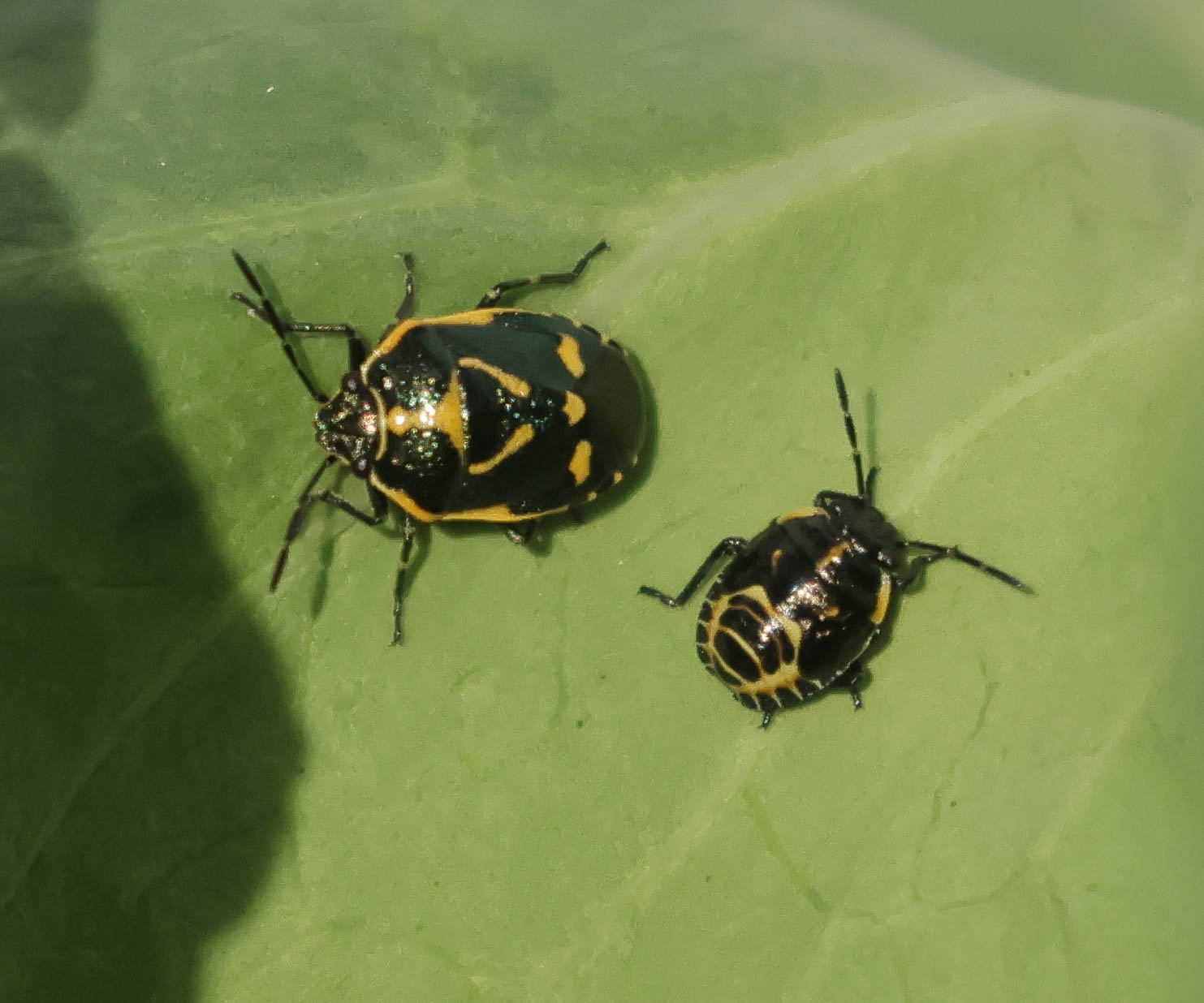
    Even better from my viewpoint, was there were two Brassica Bugs. These are another species of Shieldbug & they were a Tick for me.
    Brassica Bug: Adult & Instar (immature)

    11 Oct 2023

    11 Oct 23 - A Last Minute Visit to St Mary's With ORCA

    A week earlier I had responded to a request for a replacement ORCA surveyor on a trip to St Mary's on 11 Oct. It didn't take more than a few seconds before I said I was available. I left early for the early hours' drive to Penzance: as there had been overnight road closure signs for October, when I drove down for the Cornish Northern Harrier. In the end, the road closures were restricted to a closure where I had to exit the A30 & immediately re-join the road. I was in Penzance nice & early for the sailing. As we got closer to the boarding time, the team leader, Phil Taylor & the third surveyor, Mike Taylor (no relation) appeared. it turns out that Mike had trained Phil, who had recently qualified as a team leader. Both lived in Cornwall & were very use to trips on the Scillonian.

    We left on time & we quickly started the ORCA survey. The sea wasn't as choppy as I expected, but a stiff SW wind wasn't helping, especially as we were surveying from the outer bridge deck. But we managed to find positions on the outer bridge deck to survey from. The crossing out was good: I saw ten Short-beaked Common Dolphins and another five Dolphins that appeared too briefly to identify. There were still reasonable numbers of large Shearwaters with at least one hundred and fifteen Cory's Shearwaters, ten Great Shearwaters, two Sooty Shearwaters and a few Manx Shearwaters. There were another twenty five large Shearwaters sp. that I didn't spent more than a few seconds looking at, as we were there to survey for Cetaceans, not Seabirds. Other highlights included six Storm-petrels and an Arctic Skua. Fortunately, we encountered a mixed Shearwater flock off the Scillies, when I was the recorder: which allowed me the chance for a bit of photography.
    A nice Shearwater montage: Sooty Shearwater, Great Shearwater & Cory's Shearwater
    A close up of the Sooty Shearwater
    Great Shearwater: I do like Great Shearwaters
    Great Shearwater: It's always a treat to see them in UK waters
    Great Shearwater
    Great Shearwater
    Great Shearwater
    Great Shearwater with a trailing Cory's Shearwater
    Cory's Shearwater: It's unusual for Cory's Shearwaters to still be in Scillies waters in October
    Cory's Shearwater: All the ones I looked at looked to be regular Cory's Shearwaters
    We arrived at the Hugh Town quayside on time. This gave me about three hours for Birding on St Mary's. I said goodbye to the others, as we had all planned different activities for our time on St Mary's.
    Coming into Hugh Town
    I checked RBA on my mobile as we arrived and there were no major rarities on the islands. I decided to head out to check the Old Churchyard, before crossing Lower Moors & having a look at Porthloo Lane. This took in some of my favourite old stamping grounds when I used to stay on St Mary's back in the 80s. The island appeared very quiet and in that walk, I was disappointed to not even see a Warbler or Crest. The highlight was seeing my first White-speck that flew up from the churchyard, before landing again. Unfortunately, it hadn't settled down when it landed & was soon on its way again.
    White-speck: I was struggling to figure out what this Moth was & wasn't surprised to find the reason why: is was a Moth Tick
    I carried on & bumped into a small crowd by the ex-Old Town cafe. I hadn't bothered to pay any attention to where the scarce species were when I checked RBA, so I wasn't sure what was where on the islands. I asked the first Birder & got told, "It's on the fence". It was & it was a nice Wryneck sat fully in the open, until I raised the camera: at which point it flew into the back gardens of the bungalows. I wasn't going to hang around for longer views, so headed on to check the Lower Moors hide. Sure enough there was a Jack Snipe in front of the hide. No real surprise that one was on view, given this hide must be one of the best places in the country to see a Jack Snipe in the open.
    Jack Snipe
    Jack Snipe
    After getting some photos, I carried on along the Lower Moors path. I wasn't surprised to note that only about five of the fifty plus Birders I saw that day were actually looking. I wonder what would be found if some actually looked, rather than just walking between somebody else's Birds. But that isn't much better than the twenty percent of people Birding on the islands that I remember from the 80s. But too be fair, there were probably more Birders looking elsewhere on the other islands, or they had already checked my route & moved on elsewhere on St Mary's. I bumped into a Spotted Flycatcher which was proof there were a few migrants tucked away on the island. I was running out of time, so I decided to knock the Birding on the head, pick up a coffee for the return journey and meet Phil & Mike on the quayside.
    Mike Taylor (left) & Phil Taylor as we were leaving Hugh Town
    The wind had eased and the skies were nice & overcast: which were helpful conditions for the survey. I saw another six Short-beaked Common Dolphins, a Risso's Dolphin & 2 Harbour Porpoises on the return trip.
    Short-beaked Common Dolphin: The priority on seeing a Cetacean is to alert the recorder, note the angle from the ship's course and how far they are below the horizon on the ORCA binoculars (which have a vertical scale in the right eye-piece)
    Short-beaked Common Dolphin: Having passed the details of the species, number of individuals, their initial position, course & behaviour to the recorder, there is rarely time for any photographs. So, it was nice to be able to get a couple of shots of one of the Short-beaked Common Dolphins
    Again, there were over a hundred Cory's Shearwaters, along with a handful of Great Shearwaters, Sooty Shearwaters, Manx Shearwaters, two Storm-petrels and a Bonxie.
    Sooty Shearwater: This Sooty Shearwater wasn't impressed that the Scillonian was heading straight for it
    Far too quickly, we could see Mousehole and the survey was coming to an end as the light gave out. It had been a long, but enjoyable day. We had been lucky with the weather on the return trip, as the forecast was for rain setting in during the late afternoon. Fortunately, the timing worked out perfectly and the rain didn't set in until I reached the chippy at the Hayle. The rain didn't ease for the rest of the drive back to Dorset. With two sets of road closures and over an hour of diversions, then I ended up getting home a lot later than planned. Still better the diversions were on the return trip, than the drive to Penzance.

    7 Oct 2023

    7 Oct 23 - Fortunate Timing

    Making commitments in October is always a risk. But a Marinelife training course was being run at Ferrybridge & I decided to take the opportunity to complete the course locally: so that I can apply for Cetacean & Seabird surveys for Marinelife. But I was worried that something really good would turn up & either I would have to have a skip the course or spend the day worrying that the goodie would stay for another day. This time the Birding Gods were looking after me when a Grey Phalarope turned up at Ferrybridge on 6 Oct & quickly moved onto one of the small pools by the car park. Despite the good views, I couldn't justify driving to Weymouth to see it, having seen quite a few Grey Phalaropes over the years.
    Grey Phalarope: Juv moulting to 1st Winter. They are seen annually in Chesil Cove during strong South West blows, but they are much less common on the pools at Ferrybridge
    I headed down the following day for the course & checked the Southern end of the car park. There had been no news. But there were about six local toggers, none of which had made any effort to put the news out. But no surprise for the "I'm All Right Jack" toggers. Maybe they had put the news out on the local Whatsapp group, but if you aren't in that little clique, then you won't hear. Whatsapps is a really bad application as it has meant a lot of Bird news in Dorset is no longer broadcast in real time, apart to the local cliques: many of whom are not regular field Birders, but happy to twitch when others find them local Birds. The Grey Phalarope had flown out of view, but it had done that before & they were confident it would return. I headed down to the Dorset Wildlife Trust for the course, with a plan to have a look at lunchtime. Sure enough it was showing well at lunchtime, so I skipped the food in favour of the camera.
    Grey Phalarope: Juv moulting to 1st Winter. At least one of us had some food
    Grey Phalarope: Juv moulting to 1st Winter
    Grey Phalarope: Juv moulting to 1st Winter
    Grey Phalarope: Juv moulting to 1st Winter
    Grey Phalarope: Juv moulting to 1st Winter

    23 Sept 2023

    23 Sep 23 - A Tale Of Two Contrasting Twitches

    On 21 Sep 23, news broke that the UK's second Bay-breasted Warbler had been found on Ramsey Island, just off the coast near St David's in South Wales. It was a Tick for everybody, as the first record had only been seen by the finders. Although I hadn't visited Ramsey Island, I knew where it was, as it was where I took a rib out to Grassholm Island, after seeing a Pied Crow in a nearby campsite. The Pied Crow had wandered around a fair bit of the East Coast of the UK before resurfacing in South Wales. It seemed an unlikely vagrant, but a few other species that I've seen or not bothered with have subsequently been accepted and I decided to tie the Cetacean & Grassholm trip into the day, rather than just to look for the Pied Crow. It was a great day in South Wales, even if the Pied Crow ended up being presumed to be an escape.
    Looking across to Ramsey Island from the mainland: It was behind the lower farm house (6 Jul 18)
    Soon after the news broke, it was confirmed that no boats were going to be able to get across to Ramsey Island due to the sea conditions. The boat company and the RSPB who own the island, didn't think that would change over the next week. This looked like one rarity that I wasn't going to see. However, that afternoon I had a call from my oldest Birding mate from school days, Pete Aley, who told me there were boats running on Sat 23rd and Pete asked if I wanted a boat ticket. Pete had heard there was to be two boats at lunchtime & had secured one of the forty places on the 12:00 boat. When news broke of two morning boats, he bought a morning boat ticket & didn't need the lunchtime ticket. Fortunately, Pete decided it was easier to pass it on, rather than to try cancelling the ticket. Obviously, I jumped at the offer, despite the uncertainty of whether it would still be there in two days' time.
    The Old Lifeboat Station: The boats run from the base of the slipway (6 Jul 18)
    The next day I was on an ORCA Cetacean Survey from Pompey to Caen & back again and out of phone signal for the whole day. One of the rules is, that phones have to be turned off when we are on the bridge & I wasn't going to pay roaming changes to check the news when we were briefly tied up in Caen. It was only when it was dark and we were off the bridge and approaching the Isle of Wight that I turned my phone back on again. Fortunately, the Bay-breasted Warbler was still there. There was also confirmation from Pete that the boats were expected to run as planned. I had planned to head straight to South Wales from Pompey, as I wouldn't have got a lot of sleep if I had taken the longer route via Dorset. Soon after crossing the M4 bridge, I pulled off on a road towards Magor, the site of the 1981 American Bittern and I found a pull in where I could sleep in the Focus Hotel for a few hours. I was awake about 06:30 and after brewing a coffee, I was heading West. Fairly quickly, news came through that the Bay-breasted Warbler was still present. The weather was looking good, the boats were expected to run & everything seemed good with the world.
    The Old Lifeboat Station Slipway (6 Jul 18)
    The day became a lot more complicated mid-morning when news that the UK's first Canada Warbler had been found at St Govan's Head about an hour and a quarter driving time from Ramsey Island. I knew I didn't have time to consider looking for it on the way to St David's. What I didn't know was how long we were due to have on the island. I could only push on for the boat to Ramsey Island. I arrived in good time about ninety minutes before the boat was due to leave. There were a lot of old mates already in the queue for the boat and it was an enjoyable chance to catch up with their news over recent years. We were told that the boat was on a scheduled round the island trip, but if everybody was present, then we would be able to head off a few minutes early. Being aware of the Canada Warbler, the boat company said they would run boats back on demand, providing there was at least twenty people ready to depart from Ramsey Island. This could allow us to see the Bay-breasted Warbler and depart quickly to give a couple of hours to look for the Canada Warbler. All very frustrating, but with news it was going to be strong winds & rain all of the following day, then getting the chance to look for the Canada Warbler that afternoon was going to be the best option.
    The Bay-breasted Warbler was frequenting the bushes to the right of the farm house
    Finally, our names were called & we headed off to the old lifeboat station and down the ramp to the boat. Fortunately, there weren't checking people's Id and that saved me having to explain why my name had changed to Pete for a few hours. Within fifteen minutes of departing, we were getting off the boat on Ramsey Island. We had to wait for everybody to get onto the jetty before one of the warders who had found the Bay-breasted Warbler gave us all a briefing. Then it was a quick walk towards the farm house, where we had a second briefing from another warden of the best places to stand and to tell us where to look. Two minutes later we were looking at its favourite bushes at the back of the farm house. Within a few minutes, it was clear that people about fifteen metres to my left could see it. But we were too far away to hear the directions. Rather than race left, I decided to keep looking & hold my nerve. But all I was seeing was two Chiffchaffs, two Goldcrests and a Robin. Barry Reed had walked left, seen it, returned & given us directions to where we should be looking. I still couldn't see it. Then Barry offered me his scope to have a look. It was deeper into the bush than I had initially been looking, but now I had seen it. I quickly found it with my scope and got more views. Then it popped into a better position & I could get some photos. They weren't great, but better than nothing. It was a well-managed twitch & many thanks to the RSPB team, their volunteers and the Thousand Islands Boat crew who all really helped us to enjoy the visit to Ramsey Island.
    Bay-breasted Warbler: Not the best of photos, but it was the best I could do in the time I had
    After watching it for ten minutes, I was conscious that a number of Birders had already left for the quayside to catch the second lunchtime boat as it returned to the mainland. I decided to head to the quayside, as we didn't know how quickly the boat would return to take the next boatload off. I arrived to find there were already fifty Birders on the quayside and so I wouldn't be getting on the first boat off. At least I was in the first ten or so people for the second boat. A bit frustrating as I could have spent more time with the Bay-breasted Warbler, but as more people arrived at the quayside, I would probably have only have fifteen minutes before the second boat was also full. It was about forty-five minutes before the Thousand Islands boat arrived again to take us off. A few of the Grey Seals on the island put on a good show to keep us entertained while we waited for the boat.
    Grey Seal: Showing the long parallel nostrils that separate them from Common Seals: which are more v-shaped nostrils
    While we were waiting it, an old mate Neil Bostock heard that his driver had made it onto the first boat & had driven off to look for the Canada Warbler & stranded the rest of his car load: what a selfish ****. He should have told them he was going for the boat & given them the chance to leave promptly as well. I offered Neil & fellow passenger Mike Edgecombe a lift down to St Govan's Head. This was helpful as Mike sorted out the navigation for the final few miles & it saved me having to try figuring out the exact location on my Sat Nav. It was a smooth run down to St Govan's Head.
    Grey Seal: They can close their nostrils, so that the water doesn't get in when they dive
    Finally, we arrived at Chaos Head. We drove onto a narrow road onto part of the army firing range that was open for the weekend. There was a large car park at the end, but a number of selfish idiots were parked partly on & off this narrow road. Mike had heard the police were on the way to deal with the problem. I finally got passed the parked cars & into the car park, just before many of the parked cars were finally moved into the car park.
    Grey Seal: A good view of the long head profile of Grey Seals
    It was only a few minutes back to the wood. I got into the wood to find there were the best part of two hundred Birders in there and they were rapidly heading to the far side of wood as the Canada Warbler had just moved. Directions weren't easy to figure out in the stampede, but it quickly became clear that the small Passerine I had seen fly back towards the near side of the wood was probably the Canada Warbler. But it was only a fleeting glimpse of small Passerine to me. I headed back to its preferred area and there was a solid rank of four or five layers of Birders, with a few climbing trees to try to see. Most had twitched the UK's third Magnolia Warbler that morning & then driven onto look for the Canada Warbler, hence the large numbers of Birders.
    Grey Seal: Pup
    This was turning into one of those nightmare twitches from the Isles of Scilly in the 80s, that I hadn't seen for many years. I found a place to look from, but I had a poor view of the tops of the trees, not realising that it was favouring feeding well into the tree undergrowth and well below head height. Soon there was another stampede to the other end of the wood. I took advantage of this to get a better position. I was still three rows back, but I now had a half view. I spotted Pete Moore just in front of me & he checked if I had seen it. When he found I hadn't, he kindly offered to swap places, as he was waiting for better photos than the record shot he had taken.
    Grey Seal: Grey Seals can live for twenty-five to thirty-five years
    I now knew its preferred area. Another stampede & I shuffled left a bit & I was in the front row with a clear view of the preferred area. But after thirty minutes, it hadn't reappeared. Then there was a whispered "what's that movement" and some directions, quickly followed by "that's the Canada Warbler". Soon after I saw a very bright yellow breast of a New World Warbler. Clearly, it should have been the Canada Warbler, but with a Magnolia Warbler only two miles away and a fall of American Passerines on the Welsh coast, it was too poor a view to be sure, let alone tick it. Fortunately, I had a good, identifiable set of views as it moved right in the vegetation about five minutes later. I stayed looking for another twenty minutes or more, but I didn't get the bins on the other movements that I saw. When I turned around there were four lines of Birders behind me & it wasn't going to be easy to get out. After I few minutes, I offered my place to one of the other Birders, in exchange for a route out. When I checked outside of the wood, the Magnolia Warbler was a couple of miles away & the light wasn't going to be great, so I decided against looking for it. I wasn't too bothered as I had been on Scillies when the first Magnolia Warbler was found & I had enjoyed excellent views of that individual with about fifteen other Birders.
    Grey Seal: Ramsey Island is one of the most important Grey Seal breeding islands in the UK with between five hundred and seven hundred pups born every year
    I couldn't complain, I had seen two New World Warbler Ticks in a day & this was only the third time this century that had happened: so I should have been happy. Truth be told, I was glad to be out of the wood. The behaviour from many of the Birders was very bad, with a number of stampedes & a number of selfish idiots happy to try pushing in front of other people to try seeing the Canada Warbler. I had two people who asked to kneel in front of me. I said yes, but both realised that they were too low & then tried standing up. The first was taller than me & would have blocked my view, so he was told to behave & get down. Within a few minutes, a second Birder also tried the same trick and had also to be told to behave and sit down again. This was after several Birders had already tried blocking my view earlier in the afternoon. There was a lot of other bad behaviour from people panicking that they hadn't seeing the Canada Warbler. I was pleased to have taken the decision to use the stampedes to get a good position and be patience. This was such a frustrating twitch & contrasted totally with the very enjoyable vibe from the morning.
    Chieftain Tank at the nearby Castlemartin Barracks: Chieftain Tanks were the UK's main battle tank from 1965 to 2003
    I had a quick chat with my Welsh mate Steve Preddy, but kept it short and telling him to where to look. I finally arrived home about 01:30. I was knackered, but very happy to not be having to stay over & look for it in the strong wind & rain of the next day: when it wasn't seen. The Ramsey Island part of the day had been great, but not long enough and a real contrast with the bad twitch at St Govan's Head.