13 Feb 2014

13 Feb 14 - My Favourite Redstart

We left Laayoune city soon after dawn, but only got as far as the river at the Northern city limits before stopping for a short birding break. A good selection of Waterbirds, including an impressive raft of 53 Black-necked Grebes.
Land Rovers: This was one of the most popular vehicles in the Western Sahara & a testament to how they keep going as most were very old
Mercedes taxis: Again a very popular & common taxi in the towns
We were happy once we passed the Western Saharan border as that was the end of the regular police checkpoints. The rest of the drive North through the Anti Atlas hills was fairly uneventful, with few birds seen.
Anti Atlas scenery shot
These trees were common in the Anti Atlas
This plant was also commonly seen
Finally, we reached the excellent birding coastal river valley at Oued Massa around mid afternoon. This is the well known nature reserve which hosts most of the world population of Bald Ibises as well as a good selection of other species.
Oued Massa
It's a pity that they have allowed a football pitch within the nature reserve
Red-necked Nightjar: This was sitting on the entrance track as we were leaving at dusk. The rusty collar & the extensive spotting in the wing coverts separates it from a Nightjar 
Common Bulbul: This is the nominate barbatus subspecies which is found from Morocco to Tunisia
Blackbird: Male of the mauritanicus subspecies which occurs from Morocco to Tunisia
Moussier's Redstart: Male. This stunning Redstart occurs from South Morocco to North Tunisia
Moussier's Redstart: Male
Stonechat: Male of the rubicola subspecies which occurs in West & Southern Europe, North Africa & the Middle East
Spotless Starling: This species occurs from Spain to Corsica, Sardinia, Sicily to North West Africa
Linnet: Male of the mediterranea subspecies
Serin: Male
Serin: Male song flighting
This was a fairly common plant when we reached the coastal dunes

12 Feb 2014

12 Feb 14 - Farewell To The Desert

After 5 days in the Western Saharan Desert, we had a final few hours to check out the Sandgrouse pools at Gleb Jedane (km 21 along the Aoussard Road). Having parked up at a sensible distance to look for Sandgrouse, it was frustrating to have several tankers arriving to fill up with water in the 3 hours or so that we were there: resulting in no Sandgrouse appearing. Eventually, we gave up & headed to km 22, where John had found a few Temminck's Horned Larks the previous afternoon. Exploring the area South of the road, we found an area where Camels had been grazed & this proved to be very productive for Larks with Desert Larks, Thick-billed Larks, Temminck's Horned Larks & Thekla Larks as well as some Trumpeter Finches.
The Gleb Jidane Sandgrouse pool
Desert Lark: This is the payni subspecies. It's separated from the smaller Bar-tailed Desert Lark by a longer yellow based bill (small & pinkish in Bar-tailed Desert Lark) & the tail pattern 
Desert Lark: The diffused dark tail band separates Desert Lark from the sharply defined dark tail band of Bar-tailed Desert Lark
Thick-billed Lark: This stunning Lark occurs from Morocco to Saudi Arabia 
Thick-billed Lark
Temminck's Horned Lark: This Lark occurs from Morocco to North Arabia & South West Iraq
Temminck's Horned Lark
Thekla Lark: This is the theresae subspecies which occurs South of the Anti-Atlas hills & in the Western Sahara. This is slimmer & slightly smaller than Crested Lark with a more distinctly streaked breast & greyer upperparts
Wheatear: Male
Wheatear: Male showing the tail pattern 
Trumpeter Finch: Male 
Trumpeter Finch: This is the zedlitzi subspecies which occurs from Mauritania to Morocco, Algeria & Tunisia
Trumpeter Finch
By late morning, we started the long journey North to Laayoune. This was a fairly dull journey with few birds seen along the way. We arrived at Laayoune close to dusk. After checking into a hotel, we tried a couple of hours of spotlighting to the North East of Laayoune, but a Little Owl was the only highlight.
 Long-legged Buzzard
Taking the sheep to market

11 Feb 2014

11 Feb 14 - Some Colour Ringed Audouin's Gulls

Eventually, we arrived back into Dakhla Bay from the Aoussard Road around mid afternoon. Rather than head back to the hotel we decided to have another look for the Royal Terns. While we were watching the bay from the sand cliff, I noticed something drop over the edge of the cliff. Getting out of the car, I found a brown Wheatear on the undercliff. A quick check of the tail pattern in the book confirmed it was Black Wheatear. This is a scarce visitor to South of the Atlas & so I was pleased to see my first Black Wheatear since the trip to Morocco in 1990. Eventually Richard & John were ready to head back to the hotel for some food & sleep, so I dropped them there & after a couple of quick coffees, I returned to spend more time photographing the Gulls & Terns. On my return, I located a couple of Audouin's Gulls with colour rings. Hopefully I will be able to track down the ringer & if I do, I will add a comment to the post with the details on these individuals.
Looking over Dakhla Bay: This large area of mud & sand held a large roost of Gulls, Terns as well as smaller numbers of Flamingos & Waders 
The sandy cliff overlooking part of Dakhla Bay: Nearby was a Black Wheatear as well as good views of the Gulls and Terns
Cormorant: The maroccanus subspecies has more white in the belly of the immatures than the nominate carbo subspecies
Turnstone
Turnstone
Audouin's Gull: Colour ringed adult. The left leg is white over pale green & the right leg has a metal ring with 61 (perhaps 615) on it
Audouin's Gull: Close up of the ring
Audouin's Gull: Colour ringed 2nd Winter. The left leg has a wide white ring with BN7C on it & the right leg has a metal ring 
Audouin's Gull: Close up of the ring
Audouin's Gull: 1st Winter
Caspian Tern
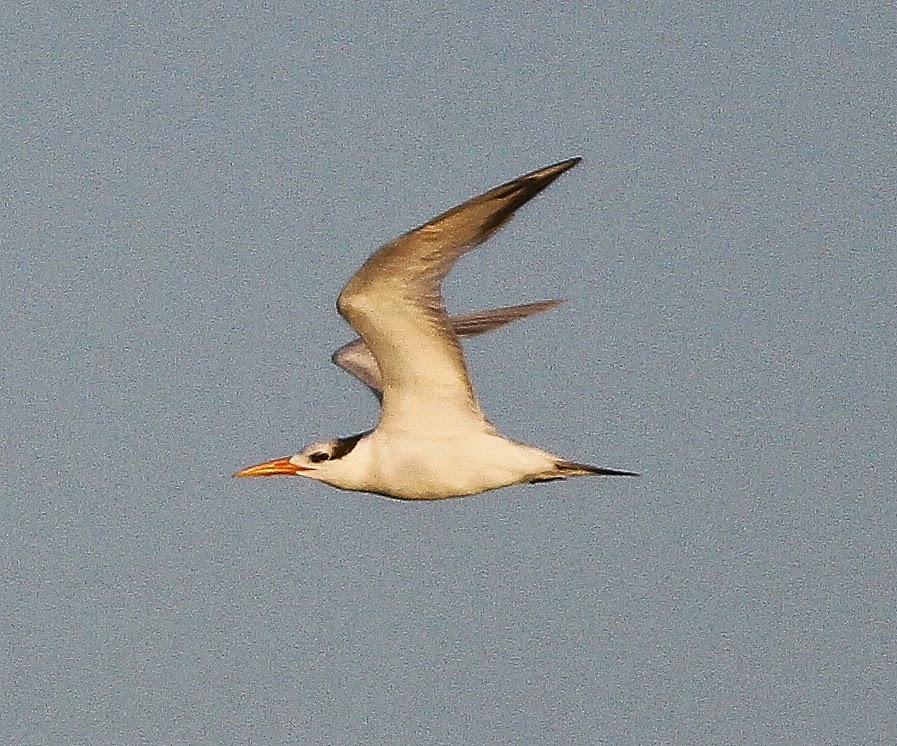
Royal Tern: This is the albididorsalis subspecies of African Royal Tern. I think that the ones that have turned up in the UK before are the American maximus subspecies
Royal Tern
Sandwich Tern
Sandwich Tern
Hoopoe Lark
Hoopoe Lark
Black Wheatear: The brown colouration and T shaped tail pattern with the tail broad band confirm this is a Black Wheatear, rather than an immature White-crowned Black Wheatear