21 Jun 2014

21 June 14 - Sandwiches Are Provided On This Island

Birding trips to islands are normally a lot of fun. Islands are great as they have a different balance of species to the adjoining mainland, as some species have never made it to the island or died out. But sometimes species have flourished on the island, despite being wiped out on the adjacent mainland. Additionally, there is always the boat trip as well, which might produce seabirds & cetaceans, as well as the risks of seasickness. Living in Dorset, there is a limited option of islands to visit: Portland is an island only in name due to the land bridge. But we have the well known Brownsea Island & visits here are never dull. Albeit the boat trips are unlikely to provide a pelagic goodie as Brownsea is within Poole Harbour. The island is owned by the National Trust, but with the best birding areas run by the Dorset Wildlife Trust.
Brownsea Island
Living near Swanage, then it is a double pelagic trip for me to visit Brownsea. First there is the Studland chain ferry, which gives a full 5 minutes of seawatching (or harbour watching if facing West).
Studland chain ferry: Waiting for the ferry at Studland's South Haven
Studland chain ferry: Looking back to Studland's South Haven 
Studland chain ferry: Sometimes the harbour mouth can be a busy place
Having crossed the harbour mouth, then the next crossing is the yellow boat to Brownsea. This runs from Sandbanks, only a minute walk from the Studland ferry, although there are also ferries from Poole Quay.
Brownsea Ferry: I arrived just in time to catch the ferry, but for the first time ever it was already full, due to a cub pack waiting to go to Brownsea. Normally, boats are every 30 minutes, but they turned around quicker this time as there was another cub group waiting to cross
Sandwich Tern: While waiting for the Brownsea ferry to return the Sandwich Terns are happy to keep a photographer occupied as they try to catch Sand Eels in the harbour mouth
Brownsea Ferry: The other ferry had just arrived from Poole Quay 
Brownsea Lagoon: Behind this low seawall sits the DWT Brownsea lagoon
Note, there is a landing fee to land on Brownsea. But it is free to land for National Trust members or DWT members who are only visiting the DWT reserve. Make sure you have your membership card with you. There are a number of hides providing views over the lagoon. Near to the jetty is a public hide. The other hides are on the DWT reserve.
The first DWT hides: The tower hide is now closed
The Mac hide: The Mac hide sticks out into the saline lagoon & provides amazing views of some of the Sandwich Tern islands. The sailing ship is tied up alongside Poole Quay
I quickly checked the lagoon from the National Trust buildings as it's not easy to see that part of the lagoon from the DWT hides. This revealed a Spoonbill, but little else. So it was quickly onto the reserve. Despite the boats being full, most were cubs & were heading for the other side of the island as this was where Baden-Powell held his first camp, which started the Scouting movement. The vast majority of the public were sticking to the NT parts of the island, so fortunately, the reserve would be reasonable quiet for a sunny day.
Spoonbill in the Cormorant colony: Doing what they do best - sleeping. This is a colour ringed bird & looks like the bird at Middlebere on 28 May. I'm still waiting to hear back on this bird
Normally, I check the first hide, but this time I went straight for the Mac hide. This is a great place for photographing the breeding Sandwich Terns. I thought I would get in there quickly in case, the hides started to fill up with visitors later in the day: as it's not fair if the photographers hog the best corner for photographing the Sandwich Terns. But it is easier to do that when the hide is near empty. Most of the Sandwich Tern islands are fenced. It's not unusual for a photographer to complain about the fences, but most accept the explanation that there is a problem with the local Sika Deer coming onto the lagoon after dark, as they really like the vegetation on the islands. Without the fences, the Terns would face regular trampling by the Sikas, which would have a significant impact on the number that ultimately fledge. 
Sandwich Tern: Just a few of the nesting birds 
Sandwich Tern: They are well used to the tight landings to get into the islands. The really tight bit is avoiding a poke from their neighbour's beak on landing
Sandwich Tern: Adult with a Sand Eel looking for the youngster
Sandwich Tern chick: Perhaps this is the nipper the adult is looking for
Sandwich Tern: Another arrived soon after
Sandwich Tern: Couldn't resist another photo
Sandwich Tern: Like small kids, this one is complaining it's hungry
Sandwich Tern: One final flight shot
There are also Common Terns nesting on the lagoon. They are not as large as the Sandwich Terns and have a red bill with a black tip. Whereas, Sandwich Terns have a longer black bill with a yellow tip & a shaggy crest. The Sandwich Terns arrive & start nesting first & so their chicks are fairly large, while the Common Tern chicks are only just starting to hatch.
Common Tern: The red bill, black tip and clean cut cap all separate this Common Tern from the Sandwich Terns. However, there are occasional Arctic Terns to watch out for which are erratic visitors to Brownsea in the Summer & Autumn
Common Tern: I spent so long photographing the Sandwich Terns, I largely overlooked the Common Terns. Still, there will be a next time
Sika Deer: Looking very embarrassed as caught in the reeds & also as it knows that I know it wants to get onto the Tern islands

19 Jun 2014

19 June 14 - Meeting The Emperor

In most walks of life, you wouldn't expect to meet an Emperor. However, if you are into Dragonflies, then this is more likely. Emperor Dragonflies are one of the largest of the UK Dragonflies & are fairly easy to see in Dorset at the moment. However, being able to see them & being able to get a good photograph are two different things. I saw my first Emperor Dragonflies for the year flying at the RSPB Arne reserve on the 8 June. They spend a large part of the day constantly patrolling over ponds & I was unable to get any decent flight shots. Fortunately, an egg laying female that day, was more obliging. Today I was out at Swineham, one of my local Poole Harbour patches, & came across this female Emperor Dragonfly sunbathing.
Emperor Dragonfly: Female
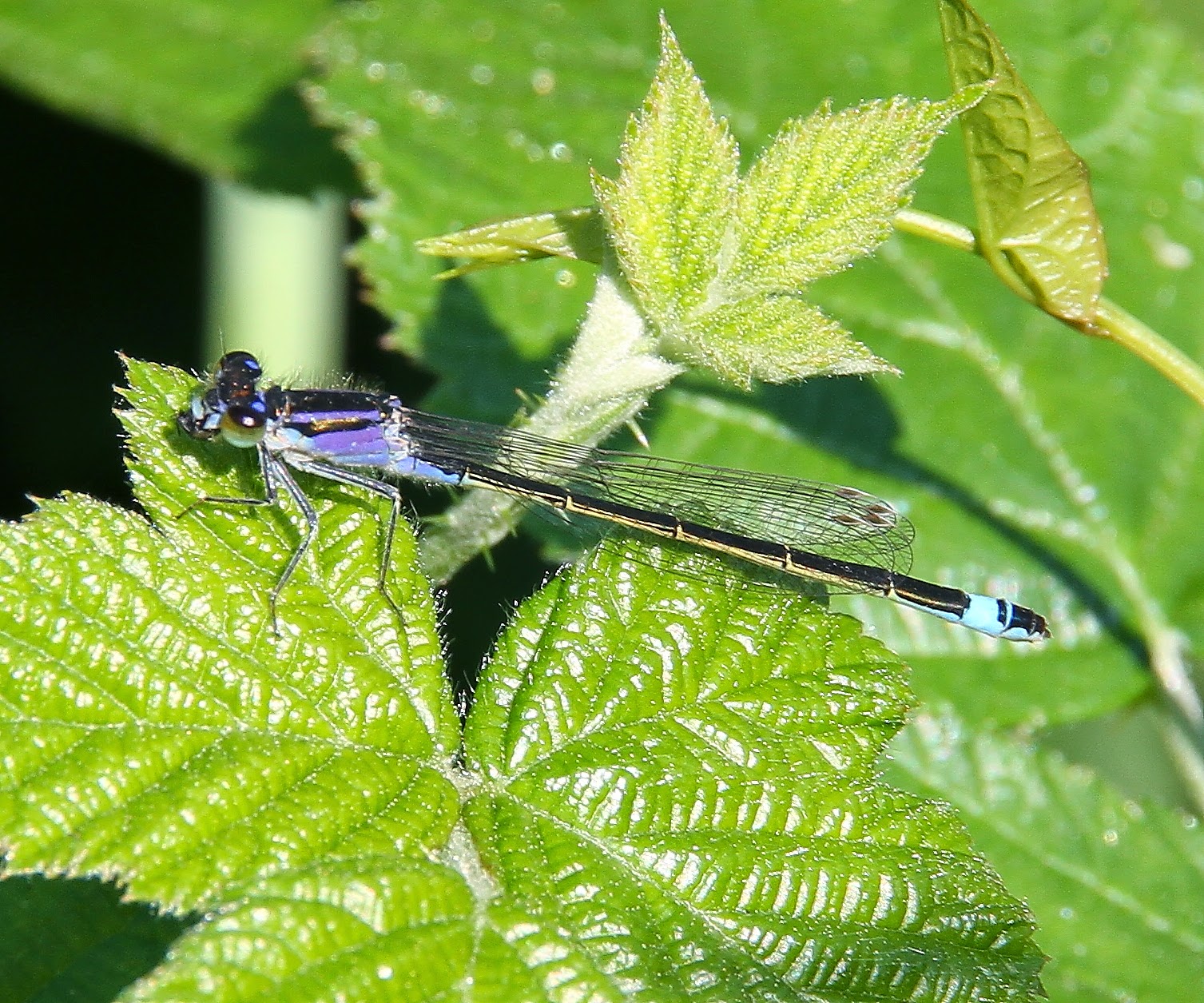
There were good numbers of Common Blue Damselflies nearby along with a few Blue-tailed Damselflies.
Blue-tailed Damselfly: Female. They can be separated from the similar looking Scarce Blue-tailed Damselflies by having the final 2 segments of the abdomen black with segment 8 blue, whereas, SBTD have the far edge of segment 8 and all of segment 9 blue. SBTD are also far less common in Dorset compared to this widespread Damselfly
Common Blue Damselfly: Male
Common Blue Damselfly: Male. The all important Segment 2 markings with the black head & shoulders marking. See Photos of the segment 2 markings on the other Dorset Blue Damselflies
Brown China-mark: This is a fairly common waterside Moth, but from an unusual group as the caterpillars are entirely aquatic and feed on water plants
It was an uninspiring day for seeing birds and this Song Thrush was the only bird photographed.
Song Thrush

18 Jun 2014

18 June 14 - Serendipitous Sweet Hawk

The plan was to head out of the county to look for some Dragonflies that are tricky or not found in Dorset. In the end, I had no success with the Dragonflies species that I was looking for & I'll leave the general scenery shots for another blog. The main reason is I had a Honey Buzzard fly over some open countryside & don't want to indicate where I was at the time. I suspect this site is known about, but I will look up the county recorder's details, to let them know, in case it's an unknown site. It caught me by surprise, but fortunately, I still had the big lens on as I had been photographing a regular Buzzard earlier & just rattled off as many shots as I could. These few came out OK.
Honey Buzzard: Wow
Honey Buzzard: Like the yellow eye
Honey Buzzard: A bit of the upperwing
These were the best views I have had for 30 years of an HB, since a similar occasion whilst looking for Butterflies & Moths in the New Forest. As I was wasn't doing well on the Dragonfly front, I decided to keep with the sweet theme & find a cream tea, before heading home.

16 Jun 2014

16 June 14 - Photospot4: Red & Black Kites

When I first started birding in the UK, Kite identification was pretty straight-forward. If you were in central Wales, then a Kite flying over your head was going to be a Red Kite: as this was the centre of the breeding range of the less than 100 pairs in the UK. These birds were fairly resident & therefore didn't seem to wander too far. Elsewhere, then you were unlikely to encounter a Kite, but there was a very slim chance that a Black Kite could turn up in the UK: but they were national rarities. The first one I saw in the UK on the Isle of Wight in 1987 was only about the 95th UK record.
Red Kite: Once a Welsh speciality, but now a UK wide success story. I've even had 3 migrants over my garden in recent years (Southern England, June 2014)
Jump forward to 1992 & the times they were a changing. A successful reintroduction scheme was quietly launched in the Home Counties in the late 1980s. I suspect this area was selected as there were plentiful woods & fields. Also there were less Buzzards to compete with, compared to suitable locations further West. Additionally, it was well away from the established Welsh population. My first encounter with one of these Red Kites was returning from a 20 month Round the World trip in March 1992 & taking a train from Heathrow to South Wales (where my mother was living at the time). Soon after the train entered the Reading countryside, I saw a Kite quartering over the fields. I subconsciously wrote it off as a Black Kite, having seen thousands in Africa (the distinctive Yellow-billed Kite subspecies), India (where good numbers were a daily sighting) & many in parts of SE Asia & Australia. Having looked away, I suddenly remembered I was back in the UK & shouldn't be seeing Kites, especially in this area. Frustratingly, it was a now distant bird & too far away to identify. It was only when I got to talk to birding mates that I heard about the reintroduction scheme & that it would have been a Red Kite.
Red Kite: The 1992 Kite from the Reading train wasn't close to the track & colours weren't easy to see on it. Had it looked like this, then it would have been immediately obvious (Southern England, June 2014)
Jump forward again to 2014 & Red Kites are now a regular sight in many parts of the UK. I recently saw 2 on the journey from Esher Common to Goring-on-Thames (on a Dragonfly day out). I was disappointed in the numbers seen that day, given I was going through one of the hot spots around the M4 - M40 corridor. They are breeding in a number of UK counties, following additional reintroduction schemes. However, they remain a less common species in Dorset, as there haven't been any local reintroductions. We have a regular Spring migration of Red Kites which I think is from birds which winter in the South West & then move East on fine Spring days. Additionally, there are a few birds seen at other times of the year. I'm sure in time they will spread more commonly into the county, as the expanding existing Southern populations look for new breeding sites. As for Black Kites, they have also become commoner in the UK: with over 360 records by 2005 when they stop being considered by the BBRC. There are fairly regular records of Black Kites in the South West & on the East coast, but it's remains a rare bird in Dorset. There are reports, but it's never easy to figure out at the time, if these are genuine or mid-identifications of poorly seen Red Kites. Either way, they never get seen again & must remain an ongoing headache for the Dorset rarities panel to assess. If one was pinned down for a day or two, it would be a well twitched & popular bird, as it will be a long overdue Dorset Tick for many of the local birders.
Black Kite: This shows the uniform grey brown body & head & pale inner primary panel. Note, the shallow forked tail, normal length wings & tail (Kfar Ruppin, Israel, April 2014)
So a quick overview of identification between the 2 Kite species. Red Kites are longer winged and longer tailed than Black Kites. They often glide on bow shaped wings where the middle of the wings is the highest point with the wing tips noticeably curved down. This distinctive long-winged and long-tailed shape makes them easy to pick out at a distance from any of the other UK Raptors. Red Kites also have a much deeper forked tail than Black Kites, which is most obvious in the closed tail, but still obvious when the tail is spread.
Red Kite: Note, the longer & more deeply forked tail compared to a Black Kite (Southern England, June 2014)
Black Kite: They have a shorter tail with a shallower fork, a grey brown body and a diffuse pale panel on the inner primaries (Kfar Ruppin, Israel, April 2014)
Red Kites have a much more contrasting colouration with a noticeable orangey-red tail, contrasting brown flight feathers with paler rufous-brown wing coverts on the upperwing, a rufous body, a light greyish head & a pale panel on the inner wing coverts. In contrast, Black Kites are far more uniform: being a cold dull grey brown colouration with a grey brown tail, a grey brown body & again a pale panel in the inner primaries.
Red Kite: The longer wings make them appear thinner winged than Black Kites & the longer, deeper forked tail is even really obvious in the spread tail of this bird. Also note the rufous body & pale head (Southern England, June 2014) 
Red Kite: Red Kites have more rufous wing coverts, obvious rufous tail & are more contrasting on their upperparts than Black Kites (Southern England, June 2014)
Black Kite: Black Kites have a more uniform darker appearance on their upperwing & a grey-brown tail as these individuals in a large flock demonstrate (Kfar Ruppin, Israel, April 2014)
I am looking forward to getting some shots of a visiting Black Kite in Dorset. Let's hope it's not too long a wait.

14 Jun 2014

14 June 14 - Portland Welcomes A Scottish Tourist

Following my recent light-hearted posting on Scottish Independence & the impacts on our bird lists, it is great to report that a Scottish visitor seems to have taken up residence on Portland. In the long run, if it stays this will help the Dorset birders keep their fuel costs low for a year tick, but in the short term it pushed up the same fuel bills as many of us travelled to see it once it arrived. The visitor in question is a Hooded Crow. Just have to hope for the rest of the Scottish goodies (Ptarmigan, Crested Tit & Capercaillie) to also move to England ahead of the vote on Scottish Independence (see earlier post).
Hooded Crow: A long hoped for, but not expected Dorset Tick. Not a brilliant show but it looks pretty pure
The Hoodie had been found the previous morning, but was only around the Portland Bill area for around an hour or so, before departing North not to be seen again. I had assumed it would go the way of many of the Portland rarities of quickly moving through this excellent migration point. But the good news was it was back the following morning & associating with the local Carrion Crows. By the time I got there, it had been seen coming & going a couple of times to a Carrion Crow flock in the Top Fields, so it was a case of waiting to see if it would return again. Fortunately, for me, it was only a few minutes after I arrived that it was seen flying back in again, before dropping out of sight in the field. After another brief flight view, it then decided to fly right down & around the Bill area, before setting into a field there. 15 minutes later it was back with the Carrion Crow flock & the next time it flew, it headed to towards the North Eastern part of the island. Clearly, a mobile bird, but it does now seem to have settled down around a pig farm at The Grove in the North East of Portland.
Hooded Crow: It does like to fly
Hooded Crow
Carrion Crow: Complaining it wasn't getting the same interest as the visitor 
As the Hoodie didn't reappear in the next half hour, it was time to check out the temptations in the Obs book shop.
Buzzard: Over the Top Fields. This is a species that has got commoner here since I first started visiting Portland in 1978 
Swift

13 Jun 2014

13 June 14 - Down By The Riverbank

After successfully seeing the Brilliant Emerald Dragonflies, the plan was to get on the road again before the M25 got too busy. Even leaving mid afternoon, it still didn't stop me hitting slow traffic on the motorway, but eventually I was heading West on the M4 to Goring-on-Thames. This is a site for Club-tailed Dragonfly. Despite searching for the best part of 2 hours along the river bank, I failed to find any. But there were good numbers of Banded Demoiselles & a few Red-eyed Damselflies.
Goring-on-Thames: The riverbank
Goring-on-Thames: Around the viaduct is a good area for the Club-tailed Dragonflies
Banded Demoiselle: Male. I must have seen about 200 Banded Demoiselles along the riverbank
Banded Demoiselle: Female
Red-eyed Damselfly: Male. There were a half dozen along the river bank. Males have turquoise blue on the final 2 segments (segments 9 & 10) of the abdomen, while the similar Small Red-eyed Damselflies have the turquoise blue also extending onto the sides of segment 8 as well
Tree Bumblebee: This looks to be one of the commoner & easier Bumblebees to identify
The Tree Bumblebees were all on this stand of blue flowers
The Cinnabar: A common day flying Moth at this time of the year 
Ladybird sp: I suspect this is yet another variant of Harlequin Ladybird, but it might be a 10 Spot Ladybird variant. Please add a Comment if you can shed light on it's identification
Mayfly sp: Saw several of these
Stock Dove: Just managed to sneak a bird photo in on the walk back to the car
Returning home, I decided to take the scenic route along the A303 through Wiltshire & go cross country to Dorset. Usually I cut through Salisbury, but for a change decided to carry along the A303 a bit further & explore. Really glad that I did as there were a number of highlights with this route.
Stonehenge: It's still here. Looking from the A303 along the Southern boundary
The next place was the Fovant Badges. I've not heard of this before I saw there. But in 1916 these images were carved into the hillside to remember the contribution that these regiments, who wever stationed locally in transit camps, were making to the First World War effort. Well worth a visit if you're nearby.
Fovant Badges: The Royal Wiltshire Yeomanry, 6th City of London Regiment & Australian Commonwealth Military Forces (left to right). More information on the Fovant Badges & those lost to time can be found on The Fovant Badges Website
Fovant Badges: Royal Corps of Signals, The Wiltshire Regiment, The London Rifle Brigade, The Post Office Rifles & The Devonshire Regiment (left to right)
Soon after I was on small back roads heading South, when a Muntjac Deer was surprised by the roadside. Unfortunately, it disappeared through the hedge before I could get a photo. This is an introduced Deer species that is fairly common in the Home Counties & East Anglia, but uncommon at best closer to Dorset. It's the first one I've seen in the UK as I rarely visit Norfolk these days, although I heard their distinctive barking calls after dark several times, whilst working in the Home Counties last year.
Muntjac Deer: The small size of this Deer is distinctive (Periyar, Western Ghats, Jan 14)
Finally, I was passing through great downland country where some of the farmers have been convinced to set aside areas for wildlife.
Grey Partridge: Quite pleased with this shot considering how poor the light was
Brown Hare